Growth at the Speed of Safety
Growth at the Speed of Safety: Why Healing After Trauma Looks Different
For a long time, I measured progress the way most of us are taught to measure it.
How much did I accomplish?
How well did I handle something?
Did I push through?
Did I keep going?
Was I successful?
But trauma changes the math.
We spend so much time comparing ourselves with people who aren't solving the same equation.
Someone else may be walking into a room while your nervous system is scanning that room for danger.
Someone else may be making a simple decision while your brain is trying to calculate every possible outcome.
Someone else may be resting while your body is telling you that letting your guard down is dangerous.
And then we look at ourselves and wonder:
Why is this so hard for me?
Maybe that is the wrong question.
Maybe the better question is:
What has my body learned it has to do to keep me safe?
I Learned How to Endure
There is something I said during my recent solo episode of Real Talk with Tina and Ann that really sums up a large part of my own story:
“I had learned to endure trauma, but I had not yet learned to escape.”
There is a difference.
Endurance can look a lot like strength from the outside.
You stay.
You tolerate.
You adapt.
You figure out how to function inside dysfunction.
You learn how to read people.
You anticipate what might happen next.
You become good at surviving things you should never have had to survive.
I became very good at enduring.
What I didn't understand was that surviving something doesn't automatically teach you how to leave it.
Sometimes survival teaches you the opposite.
It teaches you how to stay.
Trauma Trains Us
Trauma doesn't only hurt us.
It trains us.
It teaches the nervous system what to expect.
Stay ready.
Watch the room.
Don't relax too much.
Don't trust too quickly.
Prepare for what could go wrong.
For many years, I didn't understand how much of my life was being lived from that place.
Even after the danger was gone, parts of me were still preparing for it.
That is one of the reasons I think we need to change the way we talk about healing.
The body does not respond to logic alone.
It responds to safety.
You can know intellectually that you are safe and still have a nervous system that hasn't gotten the message yet.
That doesn't mean you're failing.
It means there is another part of healing that needs our attention.
When Neurodivergence and Trauma Meet
There is another layer to this conversation that is especially important to me.
I am neurodivergent.
And when neurodivergence and trauma intersect, accessing the tools that lead toward healing and freedom can be incredibly difficult.
Executive functioning, processing speed, sensory overload, communication differences, emotional regulation, working memory and the ability to shift from one state to another can all affect how someone accesses a tool.
That is why I said something during this conversation that I believe strongly:
When you are neurodivergent and living with trauma, you may have difficulty accessing the tools to freedom. We can't judge someone for that.
Having a tool available is not the same thing as being able to access it.
Knowing what to do is not always the same thing as being able to do it in the moment.
Sometimes a person needs support.
Sometimes they need repetition.
Sometimes they need someone else to help hold the steps.
Sometimes they need the tool presented differently.
And sometimes they simply need more safety before their brain and body can use it.
That is not weakness.
It is why healing must be individualized.
Progress at the Speed of Safety
What if we stopped measuring healing only by how quickly someone moves forward?
What if we measured it by safety?
Maybe progress is staying regulated during something that once caused you to shut down.
Maybe it is recognizing that you are overwhelmed before you explode.
Maybe it is saying no.
Maybe it is leaving the room.
Maybe it is staying in the room.
Maybe it is asking for help.
Maybe it is allowing someone to help you.
Maybe it is resting without explaining why.
Maybe it is realizing that the danger you feel belongs to the past, not the present.
These things may not look impressive from the outside.
But inside a nervous system that has spent years surviving?
They can be enormous.
Healing can happen quietly.
Protection Is Not Always a Wall
Part of healing has also meant learning the difference between shutting everyone out and protecting myself.
Those are not the same thing.
I used to think that if I put up a boundary, maybe I was building another wall.
But I've learned:
It is not a wall when you put up a boundary of protection. It's discernment.
Healing doesn't mean becoming accessible to everyone.
It doesn't mean removing every layer of protection and hoping nobody hurts you again.
Healthy vulnerability requires discernment.
Who is safe?
What space has been earned?
What am I comfortable sharing?
What does my body need right now?
We can become softer without becoming unprotected.
Permission to Heal
Eventually, healing required something else from me.
Permission.
Permission to stop bracing.
Permission to rest.
Permission to say no without writing a dissertation explaining why.
Permission to leave when I was overwhelmed.
Permission to stay when my instinct told me to run.
Permission to receive love instead of immediately preparing for its loss.
That last one has been particularly powerful for me.
I spent much of my life knowing how to love other people fiercely.
Receiving love was harder.
Because receiving love requires something that survival doesn't:
It requires enough safety to let someone close.
Receiving love without flinching is its own kind of healing.
Your Progress Does Not Have to Look Like Mine
This may be one of the most important things I have learned.
Healing is not a race.
There isn't one correct timeline.
There isn't a finish line everyone reaches in exactly the same way.
And there isn't a prize for getting there first.
You may need tools I don't need.
I may need supports you don't need.
Something that feels simple to one person may require tremendous courage from another.
We don't know what equation someone else is solving.
So perhaps we can stop judging progress from the outside.
Instead, we can ask:
Is this helping me feel safer?
Am I learning to listen to myself?
Am I responding differently than I once did?
Am I building a life instead of simply surviving one?
That is progress.
I Am a Success
For years, success was complicated for me.
Loss had become tangled up with achievement. Good things happened, and then terrible things happened around them. Somewhere along the way, my nervous system learned to brace even when life was going well.
Healing has required me to challenge that story too.
So I have learned to say something I once would have struggled to say:
I am a success.
Let me say that again.
I am a success.
Not because trauma didn't affect me.
Not because I handled everything perfectly.
Not because I never struggle.
I am a success because I am here.
I kept learning.
I built tools.
I raised my children differently.
I learned to use my voice.
I learned that safety can be learned.
And perhaps most importantly, I learned that I don't have to abandon myself in order to survive anymore.
That is what growth at the speed of safety means to me.
It means I am still growing.
But I am no longer demanding that my healing perform for anyone else.
I am learning to listen to my body.
To honor my limits.
To use the tools available to me.
To create new ones when the old ones don't work.
And to recognize that sometimes the bravest progress happens so quietly that no one else can see it.
You do not have to heal at someone else's speed.
You are allowed to grow at the speed of safety.
Because there is purpose in the pain and hope in the journey.
Listen to the Episode
In my solo episode of Real Talk with Tina and Ann, “Growth at the Speed of Safety,” I talk more deeply about trauma, neurodivergence, nervous-system safety, boundaries, survival, receiving love and what it means to finally give ourselves permission to heal.
If you have ever wondered why you can understand something intellectually but still struggle to make your body believe it, this conversation is for you.
And if your progress looks different from someone else's, I hope you hear this clearly:
Different does not mean less. Slow does not mean stuck. And safety is progress.

Writer/Podcaster
What do I say about myself? I love telling other people's stories, but hmmmm...Let me think.
When I think about my life, I have so many chapters. I am a very compartmentalized person.
I am first of all a mom of 5 kids. Yep...5!
I am a grandma to 5 beautiful children! All gingers lol.
I am a writer, author, podcaster, oh my gosh...I've been a journalist, columnist, hard news writer for print. I have actually won quite a few awards for my writing.
I am a photographer. I LOVE getting the money shot and capturing life! I do have a website called Spectrum Photography, but I have it offline more than on because I cannot figure out how to make the pictures work on Etsy lol. I'm not good at that kind of stuff.
I very much am an autistic individual, ADHD and dyslexic. Yep I got it all lol. I'm not that great a executive functioning, but I have many great ideas! I am trying to put things into fruition, but it just takes me longer and I probably make more mistakes, but I don' give up!!!
I have had many lives in the working world. I've worked in the jail system with helping women and talking with them, praying with them. I was the director of a battered woman's shelter/rape crisis center. I oversaw the crisis hotline at the center. I worked with abused boys. I was an Assistant Director at a school for kids with autism. I was a head swim coach for 12 years. Yep--former swimmer myself lol.
I was adopted. I've adopted 5 kids. And if you want to know the history of my crazy buffet of a family lol...I will tell you, but … Read More
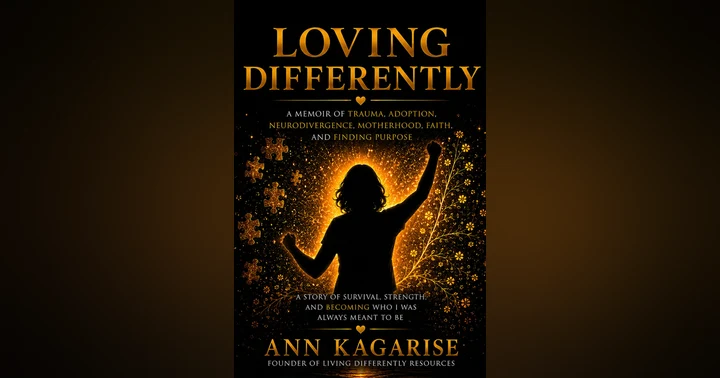
Loving Differently Tool Belt