Your Kid Belongs Here: Why Neurodivergent Children Shouldn't Have to Change to Belong

Your Kid Belongs Here: Why Neurodivergent Children Shouldn't Have to Change to Belong
By Ann Kagarise
What if the problem isn't that neurodivergent children don't fit into the world, but that the world hasn't made enough room for them?
That question was at the heart of my conversation with Katie Rose Pryal, JD, PhD, on Real Talk with Tina and Ann. And as both a neurodivergent adult and a mother raising neurodivergent children, it is a question I have spent much of my life trying to answer.
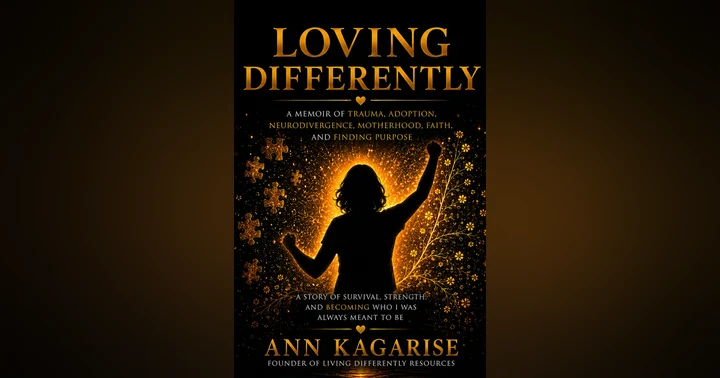
I know what it feels like to grow up in a world that measures your abilities against everyone else's. I was diagnosed with significant learning differences as a child and told that I would not graduate from high school in the traditional way. Yet I went on to earn a master's degree, build a career, become a mother, and write my memoir, Loving Differently.
But I didn't accomplish those things because my brain changed. I accomplished them because I learned to work with my brain instead of constantly fighting against it.
I built a tool belt of strategies, accommodations, and workarounds that I still use today.
Now, as a mother of five adopted children, three of whom have fetal alcohol spectrum disorder (FASD) and other neurodevelopmental differences, I find myself advocating for many of the same things I needed growing up.
And sometimes I wonder why we are still having to fight so hard for children to be understood.
What Does It Really Mean to Belong?
Katie Rose Pryal is an award-winning author, educator, and advocate whose work focuses on neurodivergence, disability, mental health, and belonging. She holds a law degree and a doctorate in rhetoric from the University of North Carolina, a master's degree in creative writing from Johns Hopkins University, and teaches in Drexel University's MFA in Creative Writing program.
As an autistic woman with ADHD and bipolar disorder, Katie brings both professional knowledge and lived experience to this conversation.
Her book, Your Kid Belongs Here: An Insider's Guide to Parenting Neurodiverse Children, published by Johns Hopkins University Press, challenges us to reconsider how we approach neurodivergent children in schools, communities, and even within our own families.
The book has been praised by Dr. Temple Grandin and recognized as a Foreword INDIES Award finalist.
What I appreciate about Katie's message is that she isn't suggesting neurodivergent children don't need guidance, support, or opportunities to develop skills.
She's asking us to examine whether the environments we've created actually allow those children to succeed.
And that is a very different conversation.
Are We Asking Our Children to Fit into Systems That Don't Fit Them?
As a parent, I have spent countless hours in meetings discussing educational goals, accommodations, behaviors, and expectations.
I have watched my children struggle with things that other children seem to accomplish effortlessly.
But I have also watched what happens when someone takes the time to understand how their brains work.
One of my children struggles with written expression. He can understand information but has difficulty getting his thoughts onto paper. When we use speech-to-text technology, we aren't giving him an unfair advantage. We are giving him access to learning.
Why should his ability to express what he knows be determined by whether he can physically write it down?
We do this in so many areas of life.
We measure intelligence by test scores. We measure success by independence. We measure behavior by compliance.
And sometimes we forget to ask whether the child actually has the neurological ability to meet those expectations in the way we're demanding.
There is a difference between a child who won't do something and a child who can't do something the way we're asking.
Understanding that difference can change how we parent, teach, and advocate.
The Damage of Always Feeling Different
This is where my own childhood comes into the conversation.
When you grow up being told what you cannot do, those messages don't simply disappear when you become an adult.
They become part of how you see yourself.
For years, I measured myself against expectations that weren't designed for the way my brain worked. I had to learn that needing accommodations didn't make me less capable.
It made me someone who needed a different pathway.
And isn't that what we should want for our children?
I don't want my children growing up believing they are broken because they learn differently, communicate differently, or process the world differently.
I want them to understand their brains, recognize their strengths, and develop the tools they need to navigate life.
That doesn't mean we remove every challenge or expectation.
It means we stop confusing support with weakness.
Accommodations aren't special treatment. They are access.
Inclusion Isn't the Same as Belonging
Something I kept thinking about during my conversation with Katie was the difference between inclusion and belonging.
We can place a neurodivergent child in a classroom and call it inclusion.
But what happens when that child cannot access the instruction, becomes overwhelmed by the environment, or is constantly corrected for behaviors related to their disability?
Are they truly included?
Or are they simply present?
Belonging means more than having a seat in the classroom.
It means having a voice. It means being understood. It means being given the opportunity to participate without constantly being reminded of everything you do differently.
And this extends far beyond education.
It applies to friendships, employment, healthcare, family relationships, and communities.
We cannot keep telling neurodivergent people they belong while expecting them to hide the very differences that make them who they are.
Maybe We Need to Change the Question
One of the biggest lessons I've learned through parenting children with FASD, autism, ADHD, and other neurodevelopmental differences is that behavior doesn't always tell us the whole story.
Sometimes a child who appears defiant is overwhelmed.
Sometimes a child who refuses to complete an assignment cannot process the instructions.
Sometimes a child who seems unmotivated is exhausted from trying to function in an environment that demands more than their nervous system can manage.
That doesn't mean every behavior is acceptable or that children don't need boundaries.
It means we need to understand what is happening beneath the behavior before deciding how to respond.
Instead of always asking, "How do we get this child to behave like everyone else?" perhaps we should ask, "What does this child need to be successful?"
That shift doesn't eliminate accountability.
It creates an opportunity for meaningful growth.
Every Child Deserves a Place in This World
Katie has written extensively about disability and mental health, including her award-winning books A Light in the Tower: A New Reckoning with Mental Health in Higher Education and Even If You're Broken: Bodies, Boundaries, and Mental Health. Her work has appeared in Psychology Today, Slate, The Chronicle of Higher Education, and other publications, and has been featured on NPR.
But what makes this conversation particularly meaningful to me isn't simply Katie's professional background.
It's that she understands what it means to live in a world that often misunderstands neurodivergence.
And so do I.
Writing Loving Differently helped me recognize how much of my life had been spent adapting, compensating, and trying to meet expectations that didn't always account for my differences.
Raising my children has taught me something equally important.
I don't want them to spend their lives believing they have to become someone else to be accepted.
I want them to have the tools they need to grow, the support they need to succeed, and the confidence to understand that their differences do not diminish their worth.
Our children will face challenges. They will need guidance, accountability, and opportunities to develop independence in ways that are meaningful and realistic for them.
But they should never have to prove they deserve to belong.
That's what I hope people take away from our conversation with Katie Rose Pryal.
Maybe we need to stop asking why neurodivergent children don't fit into the world we've created.
Maybe we need to start asking why we haven't created a world that makes room for them.
Because belonging shouldn't be something a child has to earn.
Every child deserves to belong. Not because they have learned to fit in, but because they have always had a rightful place.
Listen to our two-part conversation with Katie Rose Pryal on Real Talk with Tina and Ann, where we explore neurodivergent parenting, advocacy, accommodations, and what it really means to create a world where our children belong.
There is purpose in the pain and hope in the journey.
Ann Kagarise
Author of Loving Differently
Co-host of Real Talk with Tina and Ann

Writer/Podcaster
What do I say about myself? I love telling other people's stories, but hmmmm...Let me think.
When I think about my life, I have so many chapters. I am a very compartmentalized person.
I am first of all a mom of 5 kids. Yep...5!
I am a grandma to 5 beautiful children! All gingers lol.
I am a writer, author, podcaster, oh my gosh...I've been a journalist, columnist, hard news writer for print. I have actually won quite a few awards for my writing.
I am a photographer. I LOVE getting the money shot and capturing life! I do have a website called Spectrum Photography, but I have it offline more than on because I cannot figure out how to make the pictures work on Etsy lol. I'm not good at that kind of stuff.
I very much am an autistic individual, ADHD and dyslexic. Yep I got it all lol. I'm not that great a executive functioning, but I have many great ideas! I am trying to put things into fruition, but it just takes me longer and I probably make more mistakes, but I don' give up!!!
I have had many lives in the working world. I've worked in the jail system with helping women and talking with them, praying with them. I was the director of a battered woman's shelter/rape crisis center. I oversaw the crisis hotline at the center. I worked with abused boys. I was an Assistant Director at a school for kids with autism. I was a head swim coach for 12 years. Yep--former swimmer myself lol.
I was adopted. I've adopted 5 kids. And if you want to know the history of my crazy buffet of a family lol...I will tell you, but … Read More

Growth at the Speed of Safety