What If We Stopped Measuring Everyone by the Same Ruler?
Neurodivergent people become very good at hiding the parts of themselves that struggle. They build systems. They overprepare. They work harder than everyone around them because they believe if they just try hard enough, maybe one day they would become "normal."
The truth is, we aren't supposed to become someone else.
We are supposed to become more of who we already are.
That realization came rushing back during my conversations with Jessica Lee and Melody Valenzuela on Real Talk with Tina and Ann.
One statement kept echoing in my mind:
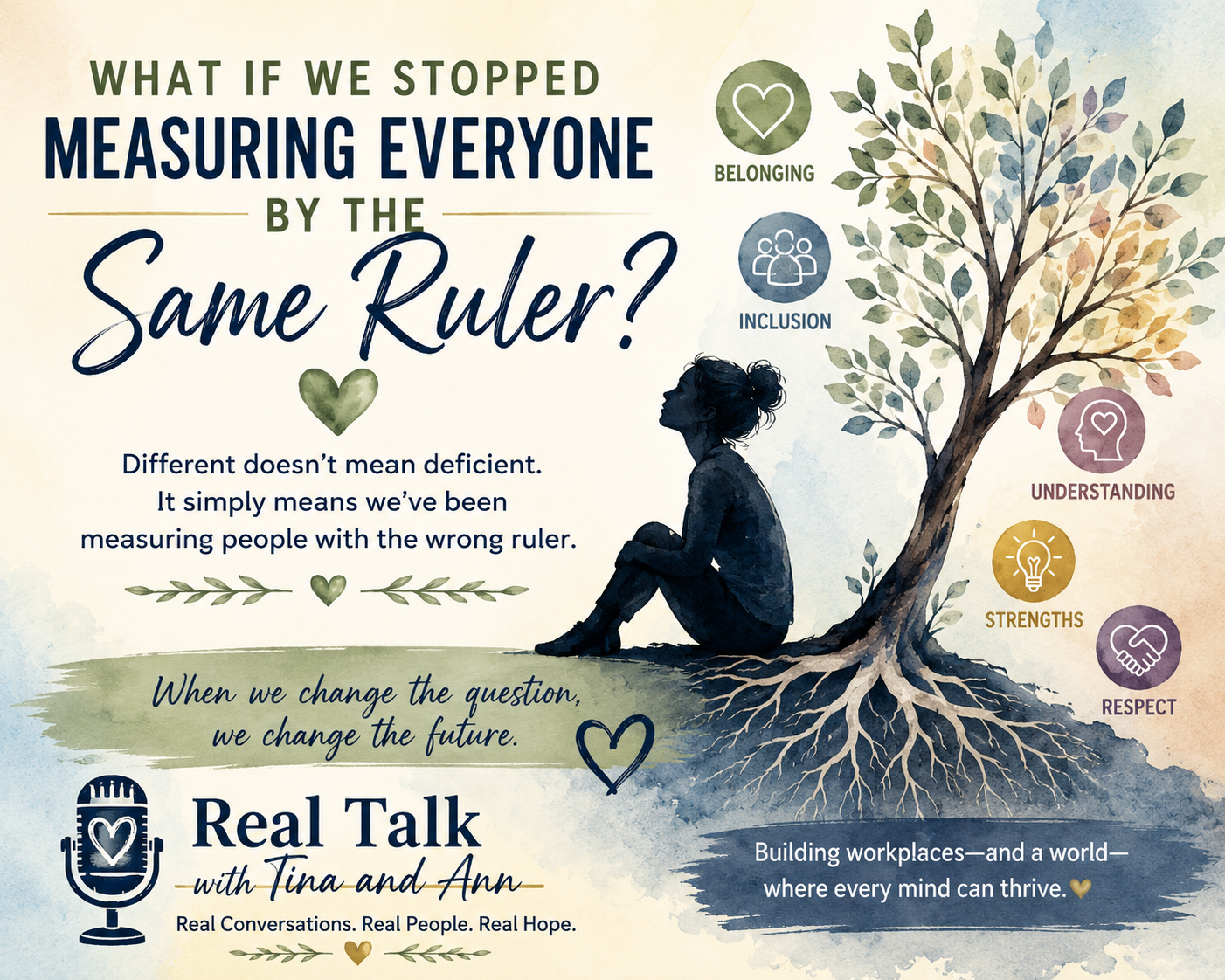
Different doesn't mean deficient. It simply means we've been measuring people with the wrong ruler.
I wish every employer, educator, parent, and leader could truly understand that.
For decades, we've built systems around one definition of success. We expect everyone to communicate the same way, process information the same way, learn the same way, interview the same way, and work the same way.
Then we wonder why so many brilliant people feel like they don't belong.
What if the problem isn't the people?
What if it's the systems?
I've spent much of my life working with children who didn't fit neatly into traditional classrooms. I've raised children whose brains process the world differently. I've lived it myself.
I've watched extraordinary strengths get overlooked because someone focused only on the challenges.
I've also watched people flourish when just one person was willing to ask a different question.
Not,
"What's wrong with you?"
But,
"What do you need to succeed?"
Those are two completely different conversations.
One assumes deficiency.
The other assumes potential.
Jessica and Melody challenged all of us to rethink the workplace, but I think the conversation is even bigger than employment.
It starts in our homes.
It continues in our schools.
It follows us into adulthood.
Belonging isn't something we should have to earn by pretending to be someone we're not.
Imagine how many gifts our world has missed because someone believed they had to hide who they were just to fit in.
Imagine what could happen if we built environments where people could bring their whole selves instead.
That isn't lowering expectations.
It's removing unnecessary barriers.
As someone who spent years believing I had to adapt to everyone else, I can tell you this:
The greatest freedom I've found hasn't come from becoming more like other people.
It's come from finally giving myself permission to be me.
Maybe that's what true inclusion looks like.
Not asking people to fit into the system.
But building systems where different kinds of minds can thrive.
Because the world doesn't need fewer people who think differently.
It needs more places where they're free to do exactly that.

Writer/Podcaster
What do I say about myself? I love telling other people's stories, but hmmmm...Let me think.
When I think about my life, I have so many chapters. I am a very compartmentalized person.
I am first of all a mom of 5 kids. Yep...5!
I am a grandma to 5 beautiful children! All gingers lol.
I am a writer, author, podcaster, oh my gosh...I've been a journalist, columnist, hard news writer for print. I have actually won quite a few awards for my writing.
I am a photographer. I LOVE getting the money shot and capturing life! I do have a website called Spectrum Photography, but I have it offline more than on because I cannot figure out how to make the pictures work on Etsy lol. I'm not good at that kind of stuff.
I very much am an autistic individual, ADHD and dyslexic. Yep I got it all lol. I'm not that great a executive functioning, but I have many great ideas! I am trying to put things into fruition, but it just takes me longer and I probably make more mistakes, but I don' give up!!!
I have had many lives in the working world. I've worked in the jail system with helping women and talking with them, praying with them. I was the director of a battered woman's shelter/rape crisis center. I oversaw the crisis hotline at the center. I worked with abused boys. I was an Assistant Director at a school for kids with autism. I was a head swim coach for 12 years. Yep--former swimmer myself lol.
I was adopted. I've adopted 5 kids. And if you want to know the history of my crazy buffet of a family lol...I will tell you, but … Read More
Growth at the Speed of Safety