
Loving Differently Tool Belt
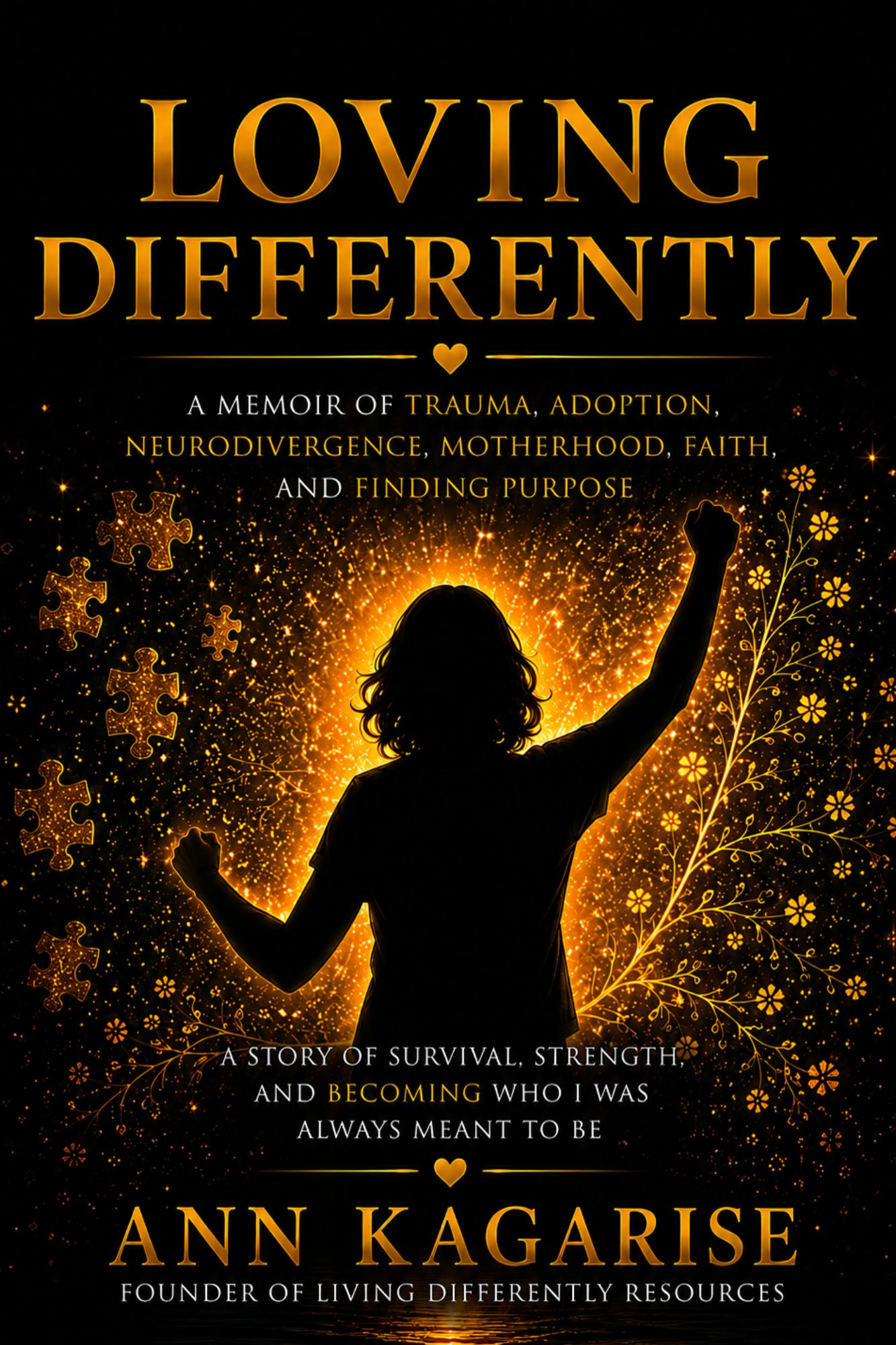
We All Build a Tool Belt
One of the biggest themes in Loving Differently is the idea of a tool belt.
Life gives us things we never asked for.
Loss.
Rejection.
Trauma.
Disability.
Grief.
Parenthood.
Mistakes.
Relationships.
Failure.
Starting over.
We don't get to choose everything that goes into our story.
But we can choose what we carry forward from it.
Over the years, I built a tool belt without even realizing I was doing it.
Self-advocacy became a tool.
Finding another way became a tool.
Boundaries became a tool.
Understanding my brain became a tool.
Using my voice became a tool.
Learning when to keep going and when to walk away became a tool.
And eventually, understanding myself instead of constantly judging myself became one of the most important tools of all.
The goal isn't to build a life where we never struggle again.
The goal is to have something to reach for when we do.
Sometimes We Treat Ourselves in Ways We Would Never Treat Someone We Love
Becoming a mother changed the way I understood myself.
I adopted five children, and as I fought for them, advocated for them, learned their needs and tried to understand the reasons underneath their struggles, something uncomfortable became very clear:
I gave my children an understanding I had rarely given myself.
If one of my children couldn't do something, I wanted to know why.
What support did they need?
Was the environment wrong?
Were they overwhelmed?
Did they understand what was being asked?
Was there another way to teach it?
But when I struggled?
I often judged myself.
I called it failure.
That realization changed me.
What if we offered ourselves the same curiosity we offer the people we love?
What if instead of immediately deciding we are lazy, difficult, broken, too sensitive, too much, or not enough, we became curious?
What do I need here?
That question can change everything.
Our Children Can Teach Us to Find Our Own Voice
I thought I was going to teach my children how to advocate for themselves.
Instead, they taught me.
I learned to walk into meetings and ask questions.
I learned to disagree.
I learned that having a seat at the table doesn't mean much if you're afraid to speak once you get there.
I learned that advocating doesn't require you to be the loudest person in the room.
It requires you to know that your voice belongs there.
As I helped my children understand their differences, I began understanding mine.
As I told them that needing support wasn't something to be ashamed of, I had to confront the fact that I was ashamed of needing support myself.
As I taught them that their brains worked differently, not wrongly, I started wondering why I had spent so much of my life believing differently meant less.
They were learning from me.
But I was learning from them, too.
Safety Can Be One of the Purest Forms of Love
For a long time, I thought love meant holding on.
Trying harder.
Giving another chance.
Understanding more.
Forgiving again.
But life taught me something else.
Sometimes love looks like safety.
Sometimes love requires boundaries.
Sometimes loving someone doesn't mean giving them unlimited access to you.
Sometimes choosing peace isn't selfish.
And sometimes the healthiest thing you can do is stop confusing chaos with connection.
This was a difficult lesson for me because I wanted love to fix things.
Sometimes it does.
Sometimes it doesn't.
And accepting that doesn't make our love less real.
Healing Doesn't Mean Pretending Everything Happened for a Reason
I don't believe every painful thing happens for a reason.
Some things are simply painful.
Some things should never have happened.
Some losses don't need to be turned into pretty lessons.
Loving Differently isn't about looking at trauma and saying, "I'm glad that happened because it made me stronger."
I'm not glad for every painful thing in my story.
But I can decide what happens next.
There is a difference.
I can take what happened to me and refuse to allow it to have the final word.
I can learn from it.
I can grow around it.
I can build something from it.
I can use what I learned to make someone else's road a little easier.
That doesn't give the pain a purpose.
It gives me purpose beyond the pain.
You Can Understand Your Past Without Living There
Writing Loving Differently forced me to look at parts of my life I had kept in separate boxes.
Adoption.
The death of my father.
Learning differently.
Trauma.
Alcohol.
Sobriety.
Motherhood.
Loss.
Advocacy.
Finding my voice.
For years, they felt like separate stories.
Writing the book helped me see the connections.
And strangely, understanding those connections didn't trap me in my past.
It helped release me from it.
There is tremendous freedom in being able to say:
Now I understand why I did that.
Understanding isn't the same as excusing everything we've ever done.
It means we can stop standing over the person we used to be and judging them with information they didn't have yet.
We can learn.
We can take responsibility.
We can grow.
And then we can move forward.
Maybe You Were Adapting All Along
This may be the lesson I wish I could give to the younger version of myself.
Maybe some of the things you have spent your life criticizing were actually adaptations.
Maybe you weren't failing.
Maybe you were figuring out how to survive with the tools you had at the time.
And now?
You get to build new ones.
That's what Loving Differently became for me.
I went into this book wanting to give other people the tools I had learned along the way.
I came out of it understanding myself much more than I did when I began.
There was healing in writing it.
There was forgiveness.
There was grief.
There was acceptance.
And there was the realization that loving differently isn't only about how we love other people.
Sometimes the person we finally need to learn how to love differently is ourselves.
Your past matters.
Your story matters.
What happened to you matters.
But none of those things get to dictate who you become next.
Take what you've learned.
Keep building your tool belt.
Find your voice.
Make room for the person you're becoming.
And remember:
There is purpose in the pain and hope in the journe

Writer/Podcaster
What do I say about myself? I love telling other people's stories, but hmmmm...Let me think.
When I think about my life, I have so many chapters. I am a very compartmentalized person.
I am first of all a mom of 5 kids. Yep...5!
I am a grandma to 5 beautiful children! All gingers lol.
I am a writer, author, podcaster, oh my gosh...I've been a journalist, columnist, hard news writer for print. I have actually won quite a few awards for my writing.
I am a photographer. I LOVE getting the money shot and capturing life! I do have a website called Spectrum Photography, but I have it offline more than on because I cannot figure out how to make the pictures work on Etsy lol. I'm not good at that kind of stuff.
I very much am an autistic individual, ADHD and dyslexic. Yep I got it all lol. I'm not that great a executive functioning, but I have many great ideas! I am trying to put things into fruition, but it just takes me longer and I probably make more mistakes, but I don' give up!!!
I have had many lives in the working world. I've worked in the jail system with helping women and talking with them, praying with them. I was the director of a battered woman's shelter/rape crisis center. I oversaw the crisis hotline at the center. I worked with abused boys. I was an Assistant Director at a school for kids with autism. I was a head swim coach for 12 years. Yep--former swimmer myself lol.
I was adopted. I've adopted 5 kids. And if you want to know the history of my crazy buffet of a family lol...I will tell you, but … Read More
Making Purpose Louder Than Pain


