Fear is not a Prophecy: Living, Showing Up, Advocating and taking Charge

Send us a text Tina and Ann explore gratitude that tells the truth in crisis: not a list, but a lifeline beside cancer, caregiving, and long grief. Kara Lockwood’s story and Robert Emmons’ research anchor practical ways to find small joys that help us keep showing up. • Cara Lockwood’s remission story and irreverent wisdom • Robert Emmons’ research on gratitude and resilience • Fake gratitude versus honest, wound-aware gratitude • Tiny joys during treatments, caregiving and daily stress • Ho...

 Apple Podcasts

 Spotify

 Castro

 RSS Feed

 Amazon Music
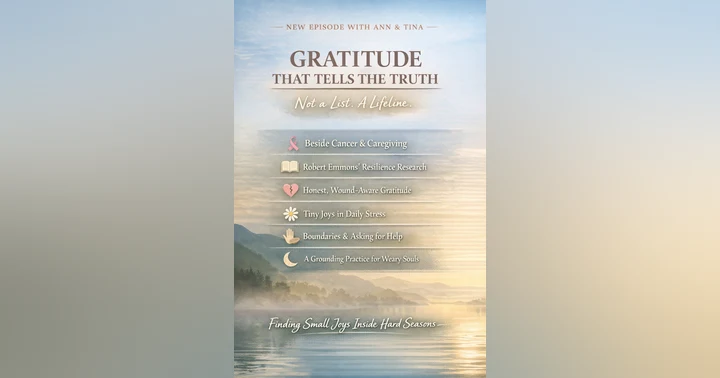
Tina and Ann explore gratitude that tells the truth in crisis: not a list, but a lifeline beside cancer, caregiving, and long grief. Kara Lockwood’s story and Robert Emmons’ research anchor practical ways to find small joys that help us keep showing up.
• Cara Lockwood’s remission story and irreverent wisdom
• Robert Emmons’ research on gratitude and resilience
• Fake gratitude versus honest, wound-aware gratitude
• Tiny joys during treatments, caregiving and daily stress
• Holidays, nostalgia and shifting traditions after loss
• Building a psychological immune system with habits
• Boundaries, clarity and stepping away from toxicity
• Practical toolkit: one-line journal, gratitude texts, asking for help
• Agency and taking back ownership during hard seasons
• Grounding practice and closing words for weary hearts
You can reach Cara and her books at Tanamachi: Rom-Com Author & Your Next Great Read!
Robert Emmerson's website and books: Gratitude Works – Robert Emmons, Ph.D., Director
If our episode helped you, please share it with someone who might be in a hard season
Join us at Real Talk with Tina and Ann | Real Talk with Tina and Ann
Please share and like and subscribe on our youtube channel. Everything helps!
Thank you for being you!
@Real Talk with Tina and Ann
00:00 - A Gritty Take On Gratitude
02:55 - Kara Lockwood’s Cancer Story
08:40 - The Science Of Gratitude And Resilience
15:30 - Fake Gratitude vs Real Gratitude
23:10 - Tiny Joys In Big Pain
31:00 - Nostalgia, Holidays, And Changing Traditions
38:30 - Psychological Immune System Tools
47:10 - Showing Up Through Caregiving Burnout
54:30 - Practical Gratitude Practices In Crisis
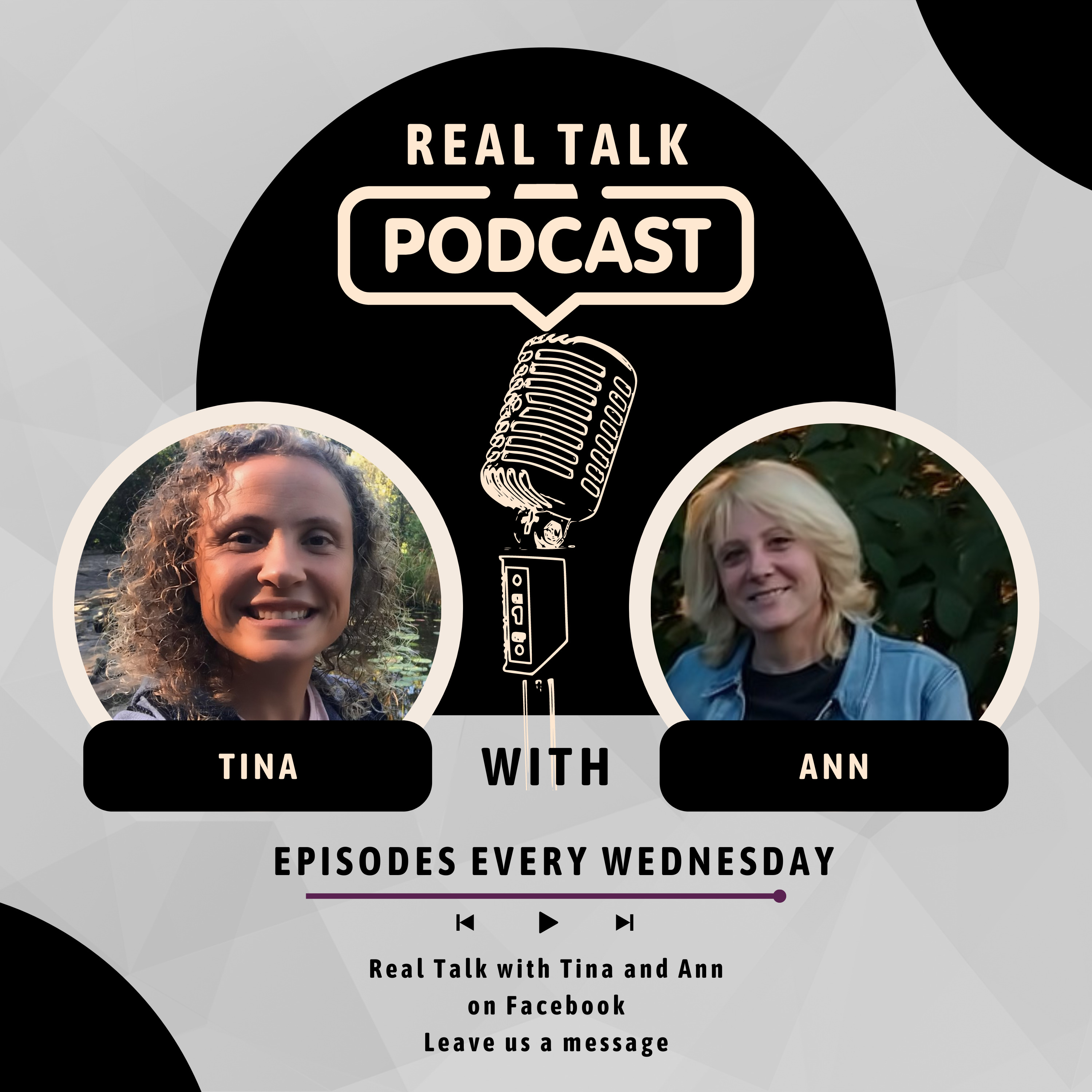
0:08 Hey friends, welcome back to Real Talk with Tina and Anne. I am Tina. And I am Anne. And we are so glad that you're here today with us. So recently, Tina, you know, I did an interview with best-selling author Kara Lockwood, and she is in remission from breast cancer. And she wrote a book called There is No Good Book for This, but I wrote one anyway: The Irreverent Guide to Crushing Breast Cancer. And in her book, she said something that stuck with me. I mean, so much stuck with me. But she was talking about gratitude in the middle of chemo, surgeries, fear, bills, and all of it. And it just hit me because this is exactly what the two of us have been talking about lately.
0:50 Oh my gosh. Can you imagine going through all of that and still having your gratitude, you know? And that's so important. You have to hang on to that. You and I were talking recently at a coffee shop, um, right after you read this book, and we were so fired up about gratitude, but not the cute, like, oh, that's so easy to come up with gratitude. It is the kind next to that big fear, or still somehow finds a reason to say thank you, even though hard times, just like you were talking about with Kara Lockwood. So don't get me wrong, there are parts that say, you know, whatever it is this stinks, because sometimes that is the best word for it. But Kara had a different take on it. And her quote, I think you'd like to share.
1:33 Exactly. I actually love this quote, and I want to build on it today. It is from Robert Emmons in his book, Gratitude Works. And he said, It is precisely under crisis conditions when we have the most to gain by a grateful perspective on life. In the face of demoralization, gratitude has the power to energize us. In the face of brokenness, gratitude has the power to heal. In the face of despair, gratitude has the power to bring hope. In other words, gratitude can help us cope with hard times. He argues there is scientific evidence that grateful people are more resilient to stress, minor or severe, and cope in better ways during difficult times.
2:19 Gratitude, he said, is a key building block to our psychological immune systems and helps us bounce back faster. There's so much that I want to just let sink in right now. There's so, yes, I agree 100%. Isn't that good? It's it's great, in fact. So today is not a gratitude list episode. This is life when your body's in shock. Gratitude when the test comes back positive. Gratitude when the diagnosis, the loss, the divorce, the addiction, the crisis hits your body and is just screaming. There's nothing good here. We're gonna talk about what real gratitude looks like in crisis, what it looked like for Cara, and there is no good book for this, what it has looked like in both of our lives, and how to practice the kind of gratitude that doesn't gaslight your pain.
3:15 So take a deep breath, pull up a chair, and if your life feels a little bit turbulent right now, you are in the right place. Okay, and when you were reading Kara's book and she was talking about chemo and surgeries and her life just turned upside down. What did that Robert Emmons quote land for you personally? Where did that land for you personally? I mean, honestly, I think it can be a big ask sometimes. I mean, basically, I'm thinking of Cara. I mean, her life just got completely flipped. And she's a mom in a blended family, five kids, three teens at home, a career deadlines.
3:57 Then she hears stage one, HER2, positive invasive breast cancer, and she goes through 16 months of a double mastectomy, chemo, immunotherapy, physical therapy, reconstruction, and her body is tired. Her mind is tired, fear is loud. And here we have this idea that in the middle of that, gratitude has the power to energize, to heal, to bring hope. And that's a bold claim. But then I think of my own life: trauma, autism, grief, adopting kids with special needs, years that felt like they were falling apart, and the moments that kept me from falling all the way to the floor were usually the tiny things, and I'm not kidding, usually the tiny things that I was still thankful for.
4:45 So I read that quote and I thought, okay, he might be on to something. I think he's definitely onto something. Years ago, over a decade ago, I read a travel log. I can't think of the name of it right now, but if I do, we'll come back to it. And in it, though, it talked about how gratitude is something that you always need to have because it will keep you grounded, it will keep you going, it will keep giving you hope. And ever since reading that, that completely changed my life. And I always try to focus on gratitude. But I will tell you, for me, uh, watching my mom's Alzheimer's progress and progress quickly since its early onset, there have been days where if one more person said, Oh, at least it's not this, or at least she's not this, or you know, still find things to be grateful for, that I might have, you know, thrown something at them.
5:42 But here's the thing: I know me and I know my deep love for gratitude and how it's shaped my life. So real gratitude and crisis feels less like a list and more like a lifeline the more I've gone through things like this. So it's not I'm thankful for everything because I'll tell you what, I'll never be thankful for my mom's disease ever. I don't find joy in it at all, and I never but I am thankful for this one thing, is what you could, you know, be thinking. I am thankful for this one thing while a hundred other things feel like they're breaking, because that is something that you'll be able to come back to and it will keep you grounded.
6:26 And I know for me, I'm five years in of my mom's diagnosis. And only now am I starting to be able to consistently without forcing myself, if that makes sense, to see and to feel gratitude, really to let light in and start shifting a little more toward that. I mean, it's like I am not thankful for the trauma. I'm thankful that today that someone texted me something nice that uplifted me, you know, during one of my really hard times. Maybe someone brought flowers and put them on my deck. That's happened before.
7:07 You know, maybe Tina stops by. You know, I realize that if someone is on your mind to reach out, do it. Because there could be a really good reason that they came to your mind. It could be as small as, you know, someone made me laugh. Someone sat with me. My adult kid sent me an I love you when she does that. That always makes me smile. You know what made me smile recently was, you know, we're getting ready to take a trip. And a good friend of mine, who I feel as though we have grown apart, dropped something off on our door the other day for us and for all of our kids.
7:51 And it was like, oh my gosh, that was, you know, so sweet, so unexpected, so thoughtful, and I'm so grateful. So yeah, it's the little things, you know. Absolutely. Yeah. And so if you're listening in, if you're in that place where life is upside down and this quote sounds great on paper, but you feel like screaming, well, you're not broken, you're human. I mean, think of Kara. Think of my story, think of Tina's story, think of your own story. While your life has felt the most upside down, can you remember one small thing that still felt like a gift?
8:31 Even when everything else was terrible. I want to tell you something that that just happened. I mean, I moved, well, I mean, not life. This is just an example. This was funny to me. Okay. I moved my desk because I have a very small space to tape. Okay. I mean, I have to share spaces. I don't have a space for just my podcast, for this podcast. So I moved the desk. I thought to myself, okay, if I'm going to take everything off and move it. No, no, I'll just move it. So there goes the coffee. There goes my microphone. There goes everything on the floor.
9:12 My computer wasn't on yet. So, but I came out of it saying, Well, I'm really glad that the coffee didn't spill on the microphone. Right? You know? That is a good thing it was a big win. Everything was on the floor, but it really was a big win because my coffee, my microphone was still fine. So I know sometimes things are like dominoes and things are falling apart, but just think of one good thing. That's so good. Well, let's talk about the difference between fake gratitude and real gratitude. Fake gratitude sounds something like everything happens for a reason. Although I've got to be honest, I really do feel that way.
9:54 I really truly do. Well, you know what? And I do too, to a certain degree. I think that some things do lead to, but in the middle of it, it's not something that you want to hear. No, it's not. And and honestly, I don't think that that's comforting to tell anyone. So I just I just sit with them. Just sit with them, listen to them. I mean, can you say that her cancer and everything that she went to happened for a reason? I don't know. I don't know what that reason would be. Sure. Sure. And you know, you could say it with my mom's Alzheimer's. Everything happens for a reason. And so you're right, it's like, but I don't get it. You know, I I'll never understand that.
10:35 So now that we're now that we're really picking it apart, it's like, well, wait, maybe I've had a false belief for a long time. That'll give me something to think about. One of the other things I love is when people say God won't give you more than you can handle. It's like, I believe that a lot of the time for those of us who are believers and have faith, that a lot of the time you are given more than you can handle. And the whole purpose is so that you rely on God to get you through it. That's what I think. And I really hate when people say, it could be worse. You know, that that is that is fake gratitude. And and you could even just call it, I would almost call it like disingenuous advice.
11:20 Don't don't say those things. Like I know a lot of people mean them well. They're not received well when someone's in the middle of a heartbreak or a heartache or whatever it may be. So just sometimes the best thing you can do is just listen and empathize truly. That that's I say that all the time. Yeah, what people need. Yeah. Somebody just wants a listening ear most of the time. Just keep your mouth shut. Remember this. You have two ears, one mouth. So you should listen twice as much as you talk. I mean, she has this whole section in the book, and one of the things that she says is most people are not going to say the right thing, and that's okay. I mean, most people just aren't because they really try and they try too hard, and they oftentimes say the wrong thing.
12:04 So yeah, I think it's good not to say things, just be, be with the person. You know, she does say in the book that if anyone tells you God will not give you more than you can handle, that she will get in line with you to punch them in the face. So I laughed so hard when I read that because I know who has gone through some of these things. And it would just be really funny to picture that. Anyway, um, fake gratitude ignores the wound. Real gratitude acknowledges the wound and says, I will see a flicker of light here. Yes. Oh, I love that. Yes. So fake gratitude is it's like putting a bow on a bomb. Real gratitude walks into the wreckage, it sits next to you, and it says, I brought a flashlight.
12:49 You know, I remember, yeah, I remember seasons in my life when people wanted me to move on or be thankful and I was still bleeding emotionally. Gratitude felt like homework. It felt like I was being asked to earn my right to be okay by pretending. But when I stopped pretending and started with very small, honest things, even when everything feels hard, the gratitude felt like oxygen. It was not fake. It lived right next to my pain. I mean, isn't that beautiful? It lives, it can live right next to your pain. Yeah, you you can have gratitude and pain living side by side. Boy, I think we've both learned that, don't you?
13:29 Yeah. Yeah. And I know many of our listeners have too. So if you're listening and gratitude has hurt you because it was used to shut you up, hear us. That is not the kind of gratitude we're talking about today. So, Anne, let's ask, let me ask you this. When you read again that Emmons quote saying gratitude can energize and heal in crisis, what is one moment in your life when gratitude actually did feel like energy and not a chore? If I focused on the negative, I would go under. And I can't do that. So I have to focus on now. And I think that really helps me if I focus on I'm not gonna fall, you know?
14:12 And it's really funny. The reason I say it that way is because I was just recently at a basketball game and I don't have good spatial sense. I kind of don't have any actually, because I don't have depth perception. And so sometimes when I'm going up or I'm in an area where there's no railings or anything, and I can't hold on to something, I honestly feel like I'm gonna fall. If I focus on that, I am going down. And that's exactly what I did. I was going up the stairs. This man was staring at me, and I started walking, and I just was thinking, I'm gonna fall. And I did. I did. I did I fell and he just looked at me like I was so weird.
14:52 Like I planned it. Because that's kind of what I think it looked like, because I was already going like this before I went down. It was so funny. And it would have looked a little strange, but I felt it because my spatial sense was so off. But that's what I'm talking about. I mean, if I focused on it and then I did it after that, you know, I had this moment where I realized if my mind is powerful enough to push me down the stairs, maybe it's also powerful enough to hold me up. I love that. The mind is a very powerful tool. I talk to myself a lot. You know, if I'm starting, I did it today. I had a list of things that I had to do, and I really didn't want to have to get to some of them and go to a few places.
15:39 And I had to give myself that pep talk. You can, you can push through, you can do this, it will get done. You are strong, all of those things, and it it did. It gave me that boost and it made me keep going. And, you know, I think what we're talking about too is again, mind is powerful, but gratitude is about a mind shift. So let's go back to Kara for a second because her story makes this real. She writes about chemo, about losing her hair, about feeling like a prisoner in her own body. Oh, that is one of my worst nightmares. She talks about being told she might have all these side effects after being toxic from chemo, and she still finds ways to laugh about it.
16:22 She jokes about picking out her new boobs with her husband and how certain boobs slosh when you run and all kinds of things. But then she says something important in the midst of the laughter. And I do think a lot of people have to, you have to turn to laughter. My dad and I will say this: we have to laugh so that we don't cry all the time. You know, sometimes that's what you have to do. You have to insert humor. So Kara, the author, says the withholding of small joys hurt more than she expected. Losing coffee, losing the food she loved, losing that comfort. So she had to work harder to find new joys. She had to cling to the joys that remained, and she reminds the reader that the old joys might come back.
17:08 You know, she said we'll come back, I say might come back. And the reason I say might, you know, I was reading a story recently. The Cleveland Clinic put out a story about nostalgia during this time of year and how holidays can make you feel stressed. And one of the things it talked about was how nostalgia, which oftentimes can bring fond memories, can also bring heartbreak, uh, which things used to be, you know. And I find myself in that position with my mom. She made the holidays special, and they just haven't been the same since she hasn't been the same.
17:49 And so it's been really hard to keep the some of the old traditions because they remind me so much of her and how much I wish she was still mentally here. And so we've tried to keep some, and then we've tried to start some new ones to I guess kind of soften the pain. And and and bring more light uh into the situation, if that makes sense. Yeah, it's it's shifting, it's trying to figure it out and change memories and bring in some good, even when that's so difficult.
18:31 I think we all try to do that, but like you just said, can you ever really get back to what was? Or it's just different. It it is. I that's that's just it. There might be some resemblance of what was, but in the end it's still different. And it doesn't always mean different is bad. It's just different. It's an adjustment and it is that mind shift. That's one thing that I've said so many times is I would just like I would like life sometimes to just stay the same. It just never stays the same. Everything changes. And a year from now, everything will be different than it is right now.
19:14 And it goes by too quick, really. And it does go by so fast. But to go back to, you know, her and being trapped in her body, I mean that it she doesn't sugarcoat anything when she's talking about it. So when Robert Emmons talks about gratitude, helping us cope in hard times, I picture Cara in that body prison taking timely inventory. Today I am thankful that this chemo chair exists. I'm thankful that the nurse knows my name. I'm thankful my husband showed up with a joke, and he was very funny in that book. I am thankful for a Taylor Swift concert in London five months from now that I am determined to get to, which you have to read her book.
19:58 I am thankful I am. Alive today, even if it is a hard day. You know, that's gritty gratitude. But that's the gratitude that's gonna save you. And it saved me. If you're listening, you feel like life has put you in a body prison or an emotional prison or a financial one. Maybe that is where this starts for you. Not with 10 things, just one. But scientifically, I would say it's it's three things at the end of the day that you write down that'll really start shifting over a month's time, really truly. You'll start to see. And you know what's really neat about it? It's usually not something big and grand. Sure, a vacation will be on the list when you take it, but there were so many times that in my darkness, I happened to just see something beautiful.
20:49 It could have just been a flower, it could have been a conversation that I had with a stranger. It could have been a thought that popped into my mind that I was grateful for. It's really neat when you practice the gratitude, the gritty kind that we're talking about. And then you can go back and reference it, and it will absolutely pull you through. So, what is one joy that you go to, um, Tina, in your head that you just reminds you of you you just say to yourself how awful you're feeling, and then you go to that joy. What is that joy? Uh, for me, it is my family, it is my health, it is that I've been given another day because I don't take days for granted.
21:34 Life is now, and I feel like I'm truly living that way. And I'm really, really grateful. So, yeah, I'm reminding myself to keep taking care of me. Um, you know, your eyes, your feet, as funny as that sounds, you know, those are things that you need to go places. And um, as I get older, I'm finding more gratitude, even in just in the simplest things that maybe we've taken for granted our whole lives. I mean, the fact that I can look at a fork and I know what to do with it and it goes in my mouth, I'm thankful. So for for me, I go back to simple little things, I go back to my health and I go back to my family, and that seems to be what keeps me going.
22:17 I know that I have purpose and I am determined to fulfill it. That's it. I think that if we narrow it down to anything, I think the fact that no matter how small it is, no matter what it is, the fact that we have purpose, I think that that's important. And if we're here, we have purpose. Absolutely. I've been thinking about that more and more. But what about for you? I'd love to know if there is something that keeps you going, like the joy, a joy that you find that you hold on to that can always bring you back to that gritty gratitude. I always go to my kids. I always go to their laughter.
22:58 Those are the things my one son has the biggest belly laugh. And it just, I mean, like you can hear it through the whole entire house. And we have a very big house. So yeah, I mean, just I'm I and a cup of coffee holding it with a blanket around me, watching some stupid nut, you know, no-brain show, you know, those kind of things. I mean, they're not really even that big, but to me, they're pretty special. Absolutely. Well, I like that Emmons, again, the person who we're talking about in the quote, talks about this as more than a feeling. He calls gratitude a key building block in our psychological immune system.
23:44 I totally agree. We talk about a lot about the physical immune system, vitamins, sleep, medicine, and things like that. But he's saying your mind's ability to bounce back is also a system. And gratitude is one of the things that strengthens it. Yeah. This to be true, you know, your brain and your gut, they're connected. So that means your physical body, your emotional well-being, it is all interconnected. Just think of it all like spaghetti. And I I kill I could not agree anymore. And I feel like the gift that I've been given during this hardest season of my life is exactly what he's talking about.
24:26 I am resilient and I will never give up. And it has given me an even more intense drive and fight to keep going, to keep fighting for my joy, even in the midst of, and you can fill in the blank. I love that. Fight for your joy. Oh my gosh, I'd love that. You shouldn't have to fight for it, but some sometimes you do. Life is hard and you have to fight for your joy. I can just feel like all the negative on top of a person, and you still have to just fight to get out of that. Take it off, drop it, let it go.
25:07 You have to still let that joy come through because that's what you were talking about before, what Kara said is that it was the little joys that she missed. And I it's talking about this too. Yes, it was the coffee for her and things like that, but I feel like for five years, things have been so dark. And yes, there's still been joy per se in their husband, but I really feel like I've been able to open up and allow it to come in now fully while also experiencing the grief along the way as things with my mom change quickly. Mm-hmm.
25:47 Yeah. And, you know, back to what Kara was saying, I mean, Kara's doctor was getting what what her doctor was getting at when he said that patients who believe that they will be fined tend to do better, not because positive thinking magically cured their cancer, but because attitude changes how we show up. And if you go into treatment already convinced you have lost, you are more likely to skip appointments, stop asking questions, stop advocating for yourself. But if you go in saying, this is awful and I'm still going to show up and I'm gonna try, you know, that changes the way that you walk through it.
26:28 It absolutely does. You know, I very much I've been a secondary caretaker for my mom for a few years now, at least once a week, sometimes several days a week, three, four, five. And uh there have been so many times where I've just wanted to say, I'm done. It's hard. I don't want to do it anymore. Not because I don't love her, because it hurts so bad. But here's the thing: I keep showing up exactly what you just said. I keep showing up, I keep trying. Okay. Gratitude does not erase the pain, but it pulls your brain just enough out of total despair that you can think, you can decide, and you can keep moving.
27:09 And that's what I do. I keep telling myself how much my mom needs me. I put myself in her shoes. I would want, I would want someone to be able to do it. Yeah, I understand you won't want to do it, most likely, because it hurts. Not because you don't want to help, but because it hurts. And so I can put myself there and I say, you keep going, you keep showing up, you keep doing the hard things because it's building me. It's broken me for so long. It's building me now. And I am excited to see the final new version of me, I guess. Yeah. I mean, that was really beautifully said. I like to think of it like this: fear is loud, anxiety is loud, grief is loud, gratitude is often quiet, and you have to invite it on purpose.
27:58 But once it's there, it turns the volume down on the other voices just enough that you can breathe again. Yes. Okay, let's let's make this really practical for a minute. So if you're in a crisis and your brain is in full survival mode, and oh my gosh, have I been there so many times? I'm sure you have too, Anne. Here are three small ways to build that psychological immune system with gratitude. Okay, this is what I was talking about just a few minutes ago. Three things before falling asleep. Before you fall asleep, name three things that you're thankful for from the day. I would encourage you to write them down.
28:40 Maybe it was the nurse was kind, the sunset was pretty, I did not cry in the grocery store today. I was able to get up and go through the day. That is all enough. It is that those are tiny wins that will add up to something big. I encourage you to write it down because you will go back to it, you'll want to, and you will be so proud of yourself and you'll see the things that really matter that pulled you up. Number two, a gratitude text. Once a day, text someone and tell them a specific thing that you're thankful for about them. So, for example, maybe it's thank you for checking on me. Thank you for making me laugh. This will help you feel more connected. Or it can be something just completely different.
29:22 I'm just glad you're my friend, just wanted to say hi and I love you. I got one of those messages today, you know, miss you. And it was like, oh, that's sweet, you know, missed you too. Think about you too. Now, number three, gratitude during the worst part. This one is hard. Pick a moment that you hate, okay, that really bothers you. The treatment chair, the waiting room, the car after you drop your kids off at therapy. In that exact moment, maybe you could say out loud one thing you're thankful for, even if you say it through gritted teeth. So this is something I work with my kids on. And I have a five, nine, and twelve-year-old all boys.
30:05 And their mind shift is pretty cool because one of them the other night, just out of the blue, prayed that grandma's disease would disappear, that it would go away. But what's really neat is one of the other boys said, but even though I still am happy my grandma's here. And I feel like that's what we're talking about here. So in the midst of the hardest season that we've ever known, where my kids are robbed of having a grandmother who is amazing, they're still thankful that she's here and that they get to have some sort of relationship with her.
30:46 It looks much different than we would have ever thought, than we would have ever liked. But I'll tell you, that right there, that gratitude during the worst part, that's where you're really going to find uh the real meat and potatoes of who you are and what keeps you going. Yeah. I mean, what about the person who's listening and is like, I can't think of one thing. I'm empty. Because there are days like that. There are, absolutely. And I've had days with my mom where I've thought, I'm not grateful. I'm tired, I'm exhausted. I'll never be grateful for the disease. I will always hate the disease. Like I said, I'm not grateful for her confusion. I'm not grateful for filling out forms, arguing with insurance, getting no help whatsoever.
31:32 So on those days, my gratitude maybe has sounded more like I'm thankful that I can just take a deep breath in and out. I'm thankful a lot of the time I go back to nature. I'm thankful that I can be outside and have a release for the pain or the anxiousness that I feel. It gives me such a release. And that I'm thankful for compassionate children because that is something that is a blessing to me always in this season of life. So if you're still listening and maybe your mind went blank when we asked, okay, think of something, then start with this. I am thankful I'm listening to this right now, because that means you've not given up.
32:14 You're still searching for hope. That's that's something. And I'm telling you, you're gonna find it. It's right here. This really resonates with me about God is that if you're angry at God or the universe or whatever it is that you want to blame something outside of yourself, you know, um, and you're still searching for hope. You know, that's something. Because I think that I always look at the opposite of love is hate, the opposite of anything that is puts out energy is something. So I mean, if you are feeling that, then you're not you haven't given up.
32:55 And I really like that. And the fact that you're still searching or that you're still angry or whatever. I mean, you're still something. And if and I am thankful that I can tell the truth about how angry I am. I am thankful that I do not have to pretend with you, with my closest people. Yeah, that's real. That's absolutely real. So wanna transition into gratitude and loss that doesn't go away. So gratitude in crisis isn't just about sickness, it's about grief too.
33:36 You know, we've we've talked a lot about you've talked a lot about your dad's death and and how that felt different for 50 years for you. So maybe, maybe a good question, a good thing that our listeners would need to hear is how has gratitude shown up in a grief that old and that deep? Isn't isn't that interesting that a grief can be that old? I think that's really interesting. Yeah, and it it leads me back to so many places in the Bible where there's so many times, so many years uh before help comes or before the answer is revealed or before the healing happens.
34:22 And I think that's real life. I mean, you know, you watch these shows and you think it has this tidy ending in 30, 60, 90 minutes. And for so many of us, it's a journey that we have to walk lifelong. Right. And I can tell you that in 50 years um since he passed away, that it never shows up to the table the same. So it's always different. For me, it has not been about being grateful for the loss itself, because of course I wouldn't be. But I am not I am not thankful at all that he died, and I'm not thankful that silence moved into our house after he was gone.
35:04 But I am thankful for the love that shaped me, for his love that shaped me, even in the very short time that I had him in my life. I am thankful for the way his absence made me pay attention to other people's pain, because it did. That's been I am thankful for the way that God has used my story to make space for the other people who are grieving. There are still days, all these years later, when the anniversary hits an I am, I am sad. Gratitude does not erase that. Gratitude just lets joy and sorrow share a table without one canceling out the other.
35:50 That's so good. I I just I can really relate to that. Surprisingly, the holidays this year are really weighing heavy on me. A lot that I miss. So I've I felt that way with my mom too. And that's the part about gratitude. I love it. Let's joy and sorrow share a table. One doesn't cancel out the other. You're not ashamed that you feel one or the other or both. There are days where I am just sad and I'm losing her in slow motion. She is trapped in her own body. This was the one thing she didn't want at all.
36:32 And then there are these tiny moments, a flash of, and it'll tear me up every time, where you look in her eyes, and it just happened this week. She called me by name, she said I love you, and she had a smile for just a moment on her face, and it gives you that glimpse of what you love, but also who you've lost. And so it's that gratitude, that joy, and that sorrow that are sitting right there. So it's in that time. My middle son always asks. I think it's so sweet when he gets home from school on the days that he knows I'm going to see grandma, how my time was.
37:19 And I tell him what I'm thankful for. You know, if it was a hard day, I I'll still find something that I was thankful for. And uh those are the little gifts for sure. That's so beautiful that you had that moment with your mom. They're not often, but I'm I'm telling you, I can feel it every time. I know she knows who I am. I I know. I just I feel it. It's not even something I can explain. We just we just know it's that love between a mother and daughter. It'll never go away.
37:59 Nothing will steal that. Nothing. No, no, I really believe that as well. I do. There's a connection that nothing severs. No, no, and I won't let it, absolutely won't let it. If you are listening and you have lost someone or you are in the middle of losing them, you are allowed to be both completely heartbroken and incredibly thankful for them and everything that you had with them at the same time. Yeah, I'm feeling it. I'm feeling it. Gratitude and grief sounds like thank you that this person existed. Thank you for our memories. Thank you that love does not end where a heartbeat does.
38:43 Wow. You have to sit in that a minute. Yeah. Okay. Um, you know, one thing that I loved about Kara's story is that her gratitude did not make her a doormat. It actually helped her cut out toxic people and say no to nonsense. And I think lots of times when you go through something really horrific, it puts things into perspective and it says, No, I don't need to put up with this anymore. You realize how short life is, and you start saying no more and you put up more boundaries. Sometimes we think gratitude means that we have to be thankful for everyone and everything and never complain.
39:27 But she used the season to say, I don't have enough energy for people who drain me. Oh, absolutely. That's, you know, my mom's disease has done that for me. It has shown me who is in my life for the long haul, at least in this season, and who isn't. And it really brings to the forefront and quick what matters and who matters. Yeah. And it really helps reshift your focus. And that's important. Real gratitude doesn't mean gratitude for abuse. Or for toxicity or for being treated badly. No, no, no. Sometimes gratitude looks like I'm thankful I finally saw the truth and stepped away, even though it hurt.
40:12 And it might even sound like I am thankful for the person who stayed, for the people who checked on me, for the one who didn't pivot away from the hard parts of my story. Absolutely. So if you're listening, if you're going through something hard that has made you see your relationships more clearly, listen, I've I've been there. You can be grateful for that clarity, even though it hurts. And it does hurt. And it's okay to acknowledge that, you know. And to the listeners, maybe your gratitude today is thank you for the one or two sturdy people that I have. And thank you that I am learning my worth. So we've talked a lot about what gratitude is and is not.
40:56 So maybe let this land with some very simple practices. Let us end. I'm sorry. Okay, let me start again. We've talked a lot about what gratitude is and what it is not. So maybe we can end with some very simple practices for this week, especially if you are in crisis. So, Anne? Yes, I mean, think of this as your even here. I am thankful toolkit. I mean, first of all, the one-line journal. Get a notebook or even the notes app on your phone. And I use that all the time, each night. Write one sentence that starts with, even here I am thankful for.
41:38 And you don't have to make it fancy. Even here I'm thankful for the nurse who smiled. Even here, I'm thankful for hot water in my shower. Even here, I'm thankful that my friend picked up the phone. And two, gratitude in the waiting room. The next time that you're in a waiting room or anywhere like that, instead of scrolling on your phone, and I mean we do this all the time. And I think I do it to shut up my mind. But maybe if my output would be something that would be really positive, I wouldn't need to do that. So close your eyes for 30 seconds instead of scrolling through the phone and ask, what good is sitting with me in this room right now?
42:20 Maybe it's the person who came with you. Maybe it's a book. Maybe it's your own courage. And third, name a person. Pick one person in your life and tell them that I'm thankful for you because and fill in the blank with something specific. Gratitude spreads when we speak it. And I want to say, Tina, I am very thankful for you because you've been a great friend to me for almost two decades. And I will always cherish you because if I called you, you would pick up. Yeah, I feel the same. I will never forget two years ago, especially calling you just completely unraveled because of a situation that was going on at my house.
43:04 And the first thing you did was come on over and you had food for me. I hadn't eaten and I don't even know when. I think when we're younger, we think that the number of friends we have matters, but that's not what it's about at all. It's about the quality of the person. And you you really, as I've gotten older, I have a core handful of friends. It's not that I don't want to make more, but I have my core.
43:44 And I know without a shadow of a doubt, I can count on them in a second for anything. And that is something I'm so grateful for. Well, let's jump back into it. So, number four, one of the other things you could do, let someone help and call it gratitude. Really, truly, so many people will say, Well, what can I do? And maybe you really don't know. But if you do know, man, I could really use a break for making dinner tonight. I could use a friend to take me to an appointment. Let people help because they really do want to. If they're asking you, they really do want to help. Don't think you bother. Don't think anything like that. Let them help because that boosts them too.
44:27 Okay. It's, you know, you can then say thank you for loving me in this way. Thank you, thank you for being there for me. Maybe it's gratitude and honest prayer. You know, you don't have to hide your feelings if you're the praying type. You can say, God, I hate this. I hate what I'm going through. I hate, you know, this disease, this diagnosis, this rating, this relationship. Um, but I am still thankful for. And you you, you know, find something. There is something always to be thankful for. And that's real. Well, this is why I say you should write things down because remembering that survival moment is gonna become key in other parts of your life when you're going through different things.
45:08 And so think of a time in the past that you didn't think you were gonna make it, and you did. And so you write it down, you remember it, and you remind yourself, boy, I thought I wasn't gonna make it through that. I can get through this too. And you will, and it will be that light, it will be that hope that keeps moving you forward. Something I I wanted to say, and I'm gonna go to my phone for this because I had written it there. I already know the story for the most part, but just it's kind of a reminder to fight, to, to take back maybe what's yours to which could be your joy.
45:49 Um, it could be a tangible thing, but I, you know, you're thinking about it in terms of joy and um to not let people tell you or the world to tell you you can't do this because whatever the reason is. So we all know Taylor Swift, and a lot of us probably know her story. And, you know, you would say, you could say that her whole life's work was stolen. You know, she had just turned 29 years old. So someone bought her entire music catalog without telling her. And so she's been re-recording these albums. She got it back. Um, but you know, she had to buy it back and then re-record. And it's taken her years to be able to do this. And everyone told her, let it go.
46:30 Everyone said, You've already made millions. The music business is brutal. Accept it, move on, make new music. But she didn't do that because here's what Taylor Swift knew that everyone else missed. Losing control of her old work didn't mean she couldn't create new versions. The songs were still hers, the recordings weren't. She made a decision that sounded insane. Re-record everything, every album, every song, note for note, start from scratch, rebuild in a very short period of time, what took her 13 years to create. Music industry experts said it was impossible. No artist had ever done this successfully on that scale.
47:13 She was told fans won't buy the same songs twice, radio won't play re-recordings, you'll destroy your legacy, all those things. She also understood again something that they didn't. She wasn't re-recording old songs. That's not just what she was doing. She was taking back ownership and was betting that her fans cared more about supporting her than they did about streaming old versions. And guess what? She was right. So her she re-released an album, Fearless, in 2021, Taylor's version, went straight to number one, outsold the original.
47:54 Fans deliberately streamed her versions instead of the old ones. Next came another album, another album. She kept going and didn't stop there. While she was re-recording, she was also releasing entirely new albums. Okay. She won Grammys, broke more records, launched the Eras tour, became the highest-grossing concert tour in history, over a billion dollars. And guess what? It wasn't from sponsorships, it wasn't from merchandise deals padding the numbers, from ticket sales and music. She became the first musician to reach billionaire status from music and touring alone. Okay.
48:34 She didn't give up. She didn't listen to any of the voices that were telling her she can't, she won't. It's not gonna pan out. She did it anyway, and she keeps doing it. Okay. So losing maybe you've lost something that you've built, but you can rebuild it. So stop listening to people who think quote, getting screwed means you're finished. That's that's not what it means. What do you want to build? You can think big, you can think small, but remember, you you just need to do it. And I just felt it was important to add that part in at this point because there are so many voices that we hear in the world saying, no, you can't for whatever reason, or this or that, or this or that.
49:25 But whether it, whether you're a Taylor Swift fan or not, the point of the story is you don't have to listen to those voices telling you no. Yeah. You can do something yourself. You can fight for that joy and you can make it happen. Yeah, it it reminds me of Kare's story, where she said, you know, cancer was in her body, but she wasn't gonna let it own her. It she she was going to take control over it. And so she did all of these things to take care of herself, to go into her surgeries. Um, she went in healthy, she did all the things.
50:06 Um, and she was just trying to take control back from cancer. And so, I mean, I think that that's really important. And it's it's just like Taylor, you know. I mean, something tried to take ownership over her, and she said, no, I'm gonna take ownership back. Yeah, that's that's what you have to do. That's that is what you have to do to overcome whatever it is, whatever obstacle is in front of you. That's what you have to do. It reminds you that your story is not only pain. I mean, I absolutely love that line, that it reminds you that your story is not only pain.
50:49 You know, none of the none of this makes cancer good. None of it makes Alzheimer's or trauma good. None of this glorifies suffering. It helps you survive. And I think if we can find anything that helps us survive, that that is what is the most important is don't let it take you down. Don't think that your story is just about the pain. So it opens up a small window in that dark, you know, and let the light in. Where, you know, I often think of Patsy Claremont's speech. She's a um a writer, and I've seen her uh speak at times where she has the cracked pot, and that's where the light comes through.
51:31 You know, the light is where the brokenness is. And I absolutely love that. And none of it glorifies suffering, it just helps us survive, like I said. So it reminds you that your story is not only the pain, make it more than that. Absolutely. I used to have a cracked piece of pottery sitting on the bathroom counter as a reminder that I'm not broken, you know, or to remind myself that light can still come through broken things if I was feeling that way. So I love that. Well, if you happen to be feeling broken or in despair, that Robert Emmons wrote about, and we want to say this to you: you are not weak because this is hard.
52:13 Hard is hard. You are not ungrateful because you're tired. You are not failing if you can't manage everything and all you can manage is just saying, thank you, that I'm still breathing. That's enough. And you have to start somewhere. Progress is still progress. You're already doing something brave by surviving today. Gratitude is not about pretending your life is fine. Gratitude is about noticing that something good is still present in a life that is not fine yet. It might be the way your kids' eyes crinkle when they laugh, the way that something, you know, that your dog does that doesn't care, you know, they don't care whether you have hair or not.
52:57 Uh, might be a Taylor Swift song in the car on the way to treatment. It might be the fact that you woke up this morning and you're listening to our voices right now that might give you that lift that you've been looking for. So before we go, if it feels okay, put your hand over your heart for a second. Feel that. That is your life. That is your story, that is your fight. Even here, I am thankful. You can whisper it if you want. Even here, I am thankful. Not for everything, not for all of it, but for something, for this breath, for this moment, for this chance to keep going.
53:40 We're grateful for you. This is something that I do actually all the time. It's a um, I put my hand on my heart and I tap myself three times to calm myself down. It's uh it's a really good grounding tool for me. We are so grateful for you, for your courage, for your honesty, for the way that you keep showing up for your own life. We will link Kara Lockwood's book, There Is No Good Book for This, but I wrote one anyway, the Irreverent Guide to Crushing Breast Cancer, on the show notes. And we will put Robert Emmons' book, Gratitude Works, there too. If you want to dig deeper into the science side of this. And if our episode helped you, please share it with someone who might be in a hard season.
54:22 Sometimes the most loving thing that we can do is sit beside someone and remind them there's still something worth being thankful for, even here. We love you. We are in this with you. You are not alone. Until next time, take care of your heart, be gentle with your body, and look for that one tiny thing today that you can say thank you for. And remember, as we always say, there is purpose in the pain and there is hope in the journey. And we will see you next time.