What Does Your Voice Say About Who You Are?
Finding Your Voice When the World Told You to Be Quiet
There is something powerful about finding your voice.
There comes a moment when you realize that silence has been costing you pieces of yourself.
Sometimes we stop speaking because we've learned that telling the truth isn't always safe. We learn to read the room instead of listening to ourselves. We become experts at adapting, masking, pleasing, and surviving.
For those of us who are neurodivergent, voice can become even more complicated.
Many autistic and ADHD individuals spend years consciously learning how to communicate in a world that wasn't designed for the way our brains process information. We rehearse conversations. We second-guess our words. We worry about saying too much, not enough, or saying it the "wrong" way.
Communication isn't always natural.
I know that feeling.
As someone who is autistic and has ADHD and dyslexia, I spent much of my life believing communication was something everyone else seemed to do effortlessly. I had to study it. Practice it. Analyze it. I wasn't finding my voice because it came naturally. I was finding it because I refused to give up.
Then there is trauma.
Trauma has a way of convincing us that silence equals safety.
One of the things that stood out to me during my conversation with Barbara McAfee was the idea that our voice is not just a sound we make. It carries our experiences, our fears, our joy, our confidence, and sometimes even our pain.
When trauma, shame, or fear settle into our lives, they often settle into our voices as well.
We begin speaking smaller.
Apologizing more.
Explaining ourselves constantly.
Or disappearing altogether.
But our voice was never meant to disappear.
It was meant to connect us.
To build relationships.
To tell stories.
To comfort others.
To advocate.
To create.
To love.
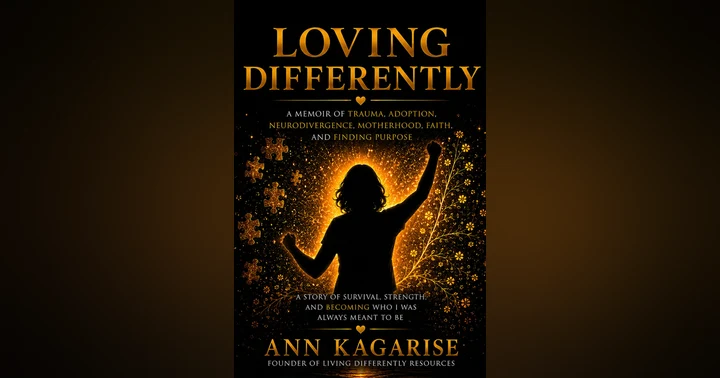
In Loving Differently, I write about learning an entirely new language of love. Real love isn't built on pretending or performing. It grows through honesty, safety, vulnerability, and understanding.
The same is true of our voice.
Finding it isn't about becoming louder.
It's about becoming more authentic.
Some of the strongest voices I've ever encountered speak softly.
Some of the most courageous people I know don't command a room.
They simply speak with honesty.
And honesty has a power all its own.
Your voice doesn't have to sound like anyone else's.
It doesn't have to be polished.
It doesn't have to be perfect.
It simply has to be yours.
So if you've spent years shrinking yourself...
If you've spent years believing your thoughts weren't important...
If you've spent years apologizing for existing...
I hope you remember this:
Your voice matters.
Not because it is flawless.
Not because everyone will agree with it.
But because it is uniquely yours.
And the world needs people who are willing to speak with authenticity, compassion, and courage.
Sometimes healing doesn't begin with finding the right answers.
Sometimes healing begins with believing your voice deserves to be heard.
Barbara asked me to write my autobiography.
I ask you to write yours. You might just be surprised what you find!

Writer/Podcaster
What do I say about myself? I love telling other people's stories, but hmmmm...Let me think.
When I think about my life, I have so many chapters. I am a very compartmentalized person.
I am first of all a mom of 5 kids. Yep...5!
I am a grandma to 5 beautiful children! All gingers lol.
I am a writer, author, podcaster, oh my gosh...I've been a journalist, columnist, hard news writer for print. I have actually won quite a few awards for my writing.
I am a photographer. I LOVE getting the money shot and capturing life! I do have a website called Spectrum Photography, but I have it offline more than on because I cannot figure out how to make the pictures work on Etsy lol. I'm not good at that kind of stuff.
I very much am an autistic individual, ADHD and dyslexic. Yep I got it all lol. I'm not that great a executive functioning, but I have many great ideas! I am trying to put things into fruition, but it just takes me longer and I probably make more mistakes, but I don' give up!!!
I have had many lives in the working world. I've worked in the jail system with helping women and talking with them, praying with them. I was the director of a battered woman's shelter/rape crisis center. I oversaw the crisis hotline at the center. I worked with abused boys. I was an Assistant Director at a school for kids with autism. I was a head swim coach for 12 years. Yep--former swimmer myself lol.
I was adopted. I've adopted 5 kids. And if you want to know the history of my crazy buffet of a family lol...I will tell you, but … Read More
Growth at the Speed of Safety