Finishing A Memoir And Finding Healing
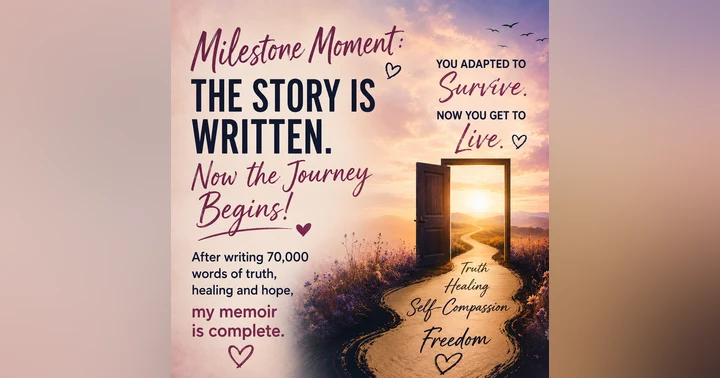
Send us Fan Mail We celebrate a personal milestone as Ann finishes her memoir and turns the writing process into hard-won lessons about trauma, neurodivergence, and self-compassion. We unpack how survival skills can masquerade as personality, and how healing starts when we stop shaming the parts of us that kept us alive. • finishing a 70,000-plus-word memoir and entering the submission process • adapting versus surviving and why the difference matters • hypervigilance, shutd...

 Apple Podcasts
 Spotify
 Castro
 RSS Feed
 Amazon Music
 We celebrate a personal milestone as Ann finishes her memoir and turns the writing process into hard-won lessons about trauma, neurodivergence, and self-compassion. We unpack how survival skills can masquerade as personality, and how healing starts when we stop shaming the parts of us that kept us alive.
• finishing a 70,000-plus-word memoir and entering the submission process
• adapting versus surviving and why the difference matters
• hypervigilance, shutdown, over-apologizing, and making yourself smaller
• neurodivergence, masking, and functioning through exhaustion
• using alcohol to take the edge off social anxiety
• replacing “what’s wrong with me” with “what happened to me”
• respecting the younger self and honoring survival without staying trapped
• when childhood protection becomes adult anxiety, isolation, and burnout
• choosing honesty, rest, safety, and connection over perfection
@Real Talk with Tina and Ann
00:00 - Memoir Finished And What’s Next
01:21 - Adapting Versus Surviving
03:27 - When Survival Becomes Identity
05:47 - Using Alcohol To Feel Normal
06:31 - The Question That Starts Healing
08:05 - When Protection Becomes Pain
09:57 - Mantra And Closing Thoughts
Memoir Finished And What’s Next
SPEAKER_00Welcome to Real Talk with Tina and Ann. I am Ann. You hear me say that so often. Right now it's just me because I came on here because I wanted to share that I just finished my memoir. 70,000 plus words. And I'm really excited about it. I sent it to a couple agents. I mean, this is going to be a really long process. I don't really know where it's going to land, but that's okay. I mean, it's all in the hands of God and whatever, and it's going to happen the way it's going to happen. And I'm going to trust it. Uh, while we're waiting, and this fun little part of my life, the actual writing part of it, is over. And it really didn't take me that long. I wish I could say that it took me years or something like that. But it actually just took me maybe about six months, I'm not sure. Um, off and on. But it's been really fun. And I've got a lot more to write. So there's that. But when I came out of it, I realized that I have uh some nuggets to share. And some of it will be from the book, some of it will be just what I'm thinking at the time, but it will just be fun. But it will also hopefully be some really good lessons along the way. And when I was writing the book, there were a lot of things that stood out to me. And those are the kind of things that I'm gonna maybe drop here and just leave it for you to pick up or not. One of the things that I've learned while I've been writing my book is adapting versus survival. And you know, I I was that way a lot of my life, and I've realized that I don't have to stay that way before I could heal. I had to understand something that changed the way that I saw myself, and a lot of what I thought was flaws was actually survival skills. For years, I thought that there was something really wrong with me because I was always very vigilant, very hyper-aware of everything around me. And I'm not gonna lie, I still do that at times. I could walk into a room and instantly feel all the energy, I could feel the tension, I could feel the change of tone. I instantly shut down. And I still do at times. It depends on the environment that I'm walking into, but I would instantly shut down shut down, I would instantly become quiet, I would instantly become the awkward one in the room, and when I would talk, I was very cautious, I would over-apologize, and I made myself smaller to keep other people comfortable. And I truly believed that that was just my personality, but it really wasn't. And it was, but I think it was the trauma and it was the neurodivergence, and it was everything wrapped in this really ugly blanket that defined who I was at the time. And those were my adaptations that I lived with. They were things that I learned to do in order to survive environments where I didn't always feel emotionally safe. When you grow up around instability and criticism and abandonment and trauma and unpredictability, your brain learns to protect you. And sometimes that protection looks like people pleasing, sometimes it looks like perfectionism, sometimes it looks like shutting down emotionally, sometimes it looks like becoming the one in the room, the strong one in the room, because no one else is going to do it. For me, survival became my identity, and when survival becomes your identity, healing feels terrifying because you start asking yourself, if I stop functioning this way, I mean it's the only way I've ever known, then who am I? And it's a really hard question to unwrap, especially for people who have spent their entire life adapting, and it really is the only way that I've ever known. And someone who is autistic, adopted, neurodivergent, I mean ABCD, F-A-S-D, no kidding, ADHD. I mean, sometimes I really do think that I have all the letters in the alphabet. And I also experienced a lot of trauma on top of that very early in life. And I think that I became incredibly skilled at reading people, masking pain, and functioning through exhaustion. I learned how to survive long before I learned how to rest. And I still don't, I still think I'm still trying to teach myself that because I'm not good at resting, I'm not good at turning my brain off. And I think a lot of people listening to this might really understand this because maybe you're the one that became the caretaker in the family. Maybe you became the achiever. Maybe you became the invisible one in the room, maybe you became funny, so no one would notice that you were hurting. And I have to say that I spent a lot of times in doing being the funny one in the room, being the goofy one. I mean, things just come to me and I say them, I have no filter at times, so it can come across as really funny, and it is, but um, on the other hand, I also I'll tell you who I was. Also, I was the one in the room who had chemicals. I uh would either drink or do some things to make myself feel a little bit better, and because I didn't feel comfortable in the room, but when I did that, when I had alcohol in my system, I felt okay. And I'm not talking like an alcoholism type of okay. What I mean is it took the edge off the anxiousness, it took the edge off of me feeling like the different one in the room, and I actually could socialize, I could socialize better, I could go up to people and have conversations and not stand out, which was really, really nice. But, you know, healing started for me when I stopped asking, what is wrong with me? Because I really felt that there was so much wrong with me. And I started asking, what happened to me that taught me that I had to become that version of myself? And the question changed everything because it replaced shame with understanding, and understanding creates compassion for yourself. I stopped despising the younger version of myself, and honestly, I mean, I really did not like, I was ashamed of who I was. I stopped looking at her as weak, broken, too emotional, too needy, too awkward, too damaged. Instead, I started seeing someone who was trying to survive with the tools that I had, someone who adapted because I had to. And honestly, I respect that version of me now. I respect the girl who kept going even when I was overwhelmed. I kept showing up. And I respect the girl who learned how to emotionally survive environments that I never should have had to navigate alone. I respect the girl who stayed soft despite of everything that tried to harden her. I respected the girl who never quit. Healing was learning I no longer had to live in permanent survival mode. Oh my gosh. And that is a very different thing. Because the truth is, some of the behaviors that protected us as children can quietly hurt us as adults. Hypervigilance becomes anxiety, self-protection becomes isolation, independence becomes fear of vulnerability, people pleasing becomes exhaustion, and eventually your body starts asking for something different. Not survival, but safety, peace, rest, connection. For me, healing has looked less like becoming perfect, and even more like becoming honest. I have had to be honest, honest about who what hurt me, honest about what shaped me, honest about who I really am, honest about the ways that I learned to survive, but also about this. I don't have to stay that version of myself that the trauma created. I can honor her without remaining trapped inside of her. And maybe somebody listening today needs to hear that. The behaviors you developed to survive difficult seasons don't make you broken, they make you human, they made you the person that had to survive. You adapted, but you don't have to stay in survival mode forever. And maybe healing begins the moment that you stop hating yourself for the ways that you learn to survive. Because maybe those parts of you were never the enemy. Maybe they were the reason that you made it through it all. Maybe they were your friend at the time and what you needed. And maybe now your job is not to shame that version of yourself. Maybe your job is to gently teach that she is finally safe enough to become something more. Remember, as I always say, my mantra at the end of every little episode that we have there is purpose in the pain and there is hope in the journey. And I will drop some more nuggets soon. See you next time.