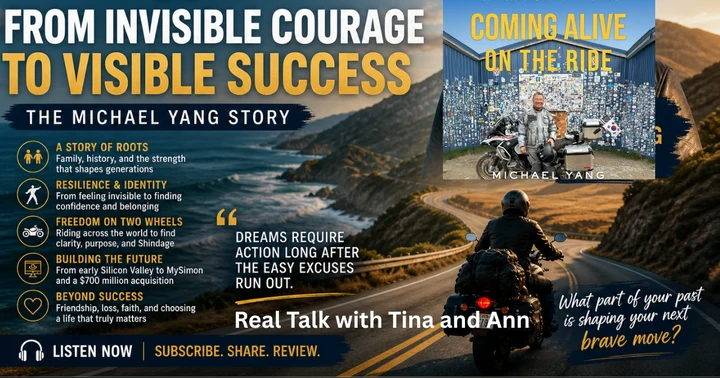
From Immigrant to 700 million dollar deal: Taking the road to discover self with Michael Yang
Send us Fan Mail The internet didn’t arrive with fanfare for most people, but Michael Yang remembers the exact moment it became real: a friend opens the Mosaic browser, types a simple URL, and information appears from far away. That flash of possibility turns into a conviction that the World Wide Web will reshape how we live and shop, long before “online commerce” becomes everyday language. We follow Michael from those early Silicon Valley days to the gritty middle chapters that rarely make ...

 Apple Podcasts
 Spotify
 Castro
 RSS Feed
 Amazon Music
 The internet didn’t arrive with fanfare for most people, but Michael Yang remembers the exact moment it became real: a friend opens the Mosaic browser, types a simple URL, and information appears from far away. That flash of possibility turns into a conviction that the World Wide Web will reshape how we live and shop, long before “online commerce” becomes everyday language.
We follow Michael from those early Silicon Valley days to the gritty middle chapters that rarely make the highlight reel: long nights, constant investor rejection, and the discipline of preparing for opportunities you cannot yet name. He shares how an immigrant instinct to compare prices becomes the blueprint for MySimon, how $25,000 in savings turns into a venture-backed rocket ship, and why a $700 million acquisition can still feel bittersweet when you get outvoted on the future you wanted.
Then the story widens into what success cannot buy: meaning, perspective, and peace. Michael talks about being pushed out of his own company, building again with Become.com, and eventually choosing a life with more freedom, motorcycle miles, and creative work. We also spend time on his friendship with Karl, the brotherhood forged on the road, and the grief that arrives when a friend dies doing what he loved. Threaded through it all is faith, including the line he closes his book with, and the idea that dreams require action long after the easy excuses run out.
If you’ve been weighing a risk, a reinvention, or a fresh start, listen and then tell us what step you’ve been avoiding. Subscribe, share this with a friend, and leave a review so more people can find the show.
@Real Talk with Tina and Ann
00:00 - Why Part Two Matters
00:54 - A Front Row Seat To Tech
02:31 - Seeing The Web For First Time
05:20 - The Idea Behind MySimon
06:37 - Selling For 700 Million Dollars
09:11 - Keeping A Promise To Mom
12:40 - Failures That Built Resilience
17:15 - Pushed Out Then Starting Again
21:53 - Motorcycle Miles And American History
26:48 - An Immigrant’s View Of America
31:56 - Carl Friendship And Brotherhood
41:13 - 67,000 Miles And The Next Ride
44:41 - Rome And A Sense Of Calling
51:10 - Going Back To Korea And Roots
55:17 - Where To Find The Book
56:40 - Faith, Fear, And Final Encouragement
Why Part Two Matters
SPEAKER_00Last week we had part one with Michael Yang, a memoir of motorcycle travel, self-discovery, and Korean heritage. If you missed part one, you really have to listen to it. And part two goes into the history of technology and how he founded a company that actually made$700 million and all he invested at the beginning was$26,000. He's really a remarkable human and you have to get to know him more. We talk about dreams and purpose and all that it takes to just keep going and take one step in front of the other to build your life to become who you want to be. It's really an incredible story. This is part two. There is nothing quite like a journey to reset you, to strip everything back and show you who you really are. And reading your story, you can feel that transformation happening in real time. Not just where you were going, but who you were becoming along the way. And there was another side to you, which I really want to talk about because it was a complete surprise. And thank you for the tech history. And I felt like I was living in it. I mean, I did live through it. And but you had a front row seat. You stood at the edge of something that changed the world. And you were there at the very beginning of the internet, before it became what we know today. Emails, early computing. You met Steve Jobs and met the founder of Pong and Atari. And you know, by the way, I owned an Atari and I played Pong. I can remember sitting in my bedroom with Pong and putting it in for the very first time and thinking this is the most amazing thing in the world. You know, it means you know, you you were a part of history. That's what you were. You were living in it. And there's this moment, you know, I stopped when I read this. There's this moment in your book that you describe, and I want you to talk about it, where they take you into the office and they like put in the words www.yahoo.com and what happens for the first time with you.
Seeing The Web For First Time
The Idea Behind MySimon
Selling For 700 Million Dollars
SPEAKER_02Yeah, so that was uh one of the biggest turning moments in my life, turning points in my life. Uh, this was around 19 um93 or 94 when there was a new invention called uh World Wide Web uh by Tim Berners-Lee uh at this uh European uh laboratory in Switzerland and Mark Andriessen, who was uh inventor of the graphic browser called Mosaic. And so I was attending um UC Berkeley High School of Business in the evening to get my MBA degree uh while I was working full-time uh in Silicon Valley. I cartpooled with other students who was also working professionals who was taking this evening class with me uh in San Francisco. So during one of those rides, you know, driving back home, one of the classmates uh he said, you know, have you heard of Mosaic Browser? I said, Oh, what's that? And he said, Well, it's a new piece of software that you could run on your PC. And through that, you could look at information from websites all around the world. And this was in 19 early 90s where, you know, computers were a pretty new thing. And computers were people using AOL or Prodigy or CompuServe to dial up at this low speed of modems at 2400 baws or 9600 baws. There was no internet back then. But then he said, it's a new invention that's that's really interesting. Well, could could I see it? And he said, sure, you could just come to my office because we had parked our cars there for carpooling and took me to his uh office and he turned on his um workstation computer at Sun Microsystem and he typed in um you know www.yamhoo.com through this mosaic browser, and then there was all kinds of information. He said that web server is located halfway across the country, and he showed me another website that was in Europe, and so I go, oh my God, this is amazing. So all kinds of light bulbs were going off in my brain because this was a revolutionary invention where computers will be all connected through the internet, and there will be all kinds of websites of different kinds of information, and you could buy things online. There was a startup called Amazon.com that were still selling books online, and there was eBay, which was an auction site where you could buy things by bidding on it. And Yahoo was Internet Portal. This was before Google became a household name. And that's when I realized, oh my God, this internet is gonna change the world. And I saw internet not only as a place of information, but also a place of commerce, buying and selling things. And over time, I developed this idea based on my own experience as an immigrant who's always compared prices at different stores to save money. I said, you know, we need to have a website where people could type what they're looking for and we compare prices across different stores for that same item so that people could save time and money when they're shopping online. And so that that became my Simon.com, a company that I founded in '98 with uh a partner who was an engineer. And I spent$25,000 of savings that I had. And we worked night and days, days and nights and weekends, worked incredibly hard for two years, raised a bunch of venture capital. I got so many rejections from investors who didn't believe me or didn't think that I could do it or we could do it. But uh few investors believed in my vision and our vision and uh invested money. So we raised like$30 million in venture capital from 98 to 2000 in less than two years. And then we're getting ready to do an IPO a Nasdaq because we grew over millions of users and hundreds of thousands of dollars of revenue. Uh that's when CNET approached us for an acquisition and they had made an offer to acquire us at what became a$700 million acquisition. So investors wanted to sell. I didn't want to sell because I wanted to keep growing it and make it into a public company and make it into a multi-billion dollar company, but they wanted to sell and I was outvoted, so I had to go along and we sold the company. But then soon after that, the dot-com bubble burst. So it was uh in hindsight great timing to sell the company at that time. But yeah, that whole journey was just uh one of the most exciting periods of my life, you know, coming to America and you know, stumbling upon, you know, and and landing in Silicon Valley. That was what's um was amazing. And that's why I thank God that God was really blessing me uh in so many different ways. And one of them was like, you know, just putting me in San Jose, California in the 70s and 80s and 90s when all these you know technological revolution was going on, starting from computers to personal computers to the internet and then the mobile. And today it's AI. And, you know, I had a chance to meet with Steve Jobs at the Macy's Department Store in 1982, uh, which I wrote about in my book Coming Alive on the Ride. That was a very interesting run-in with the founder of Apple. And later when he starts, you know, Apple Store, it reminded me of that time that I ran into him at the Macy's Department Store in San Francisco.
SPEAKER_00You guys were standing next to each other, and you were there for the exact same reason. You both wanted to try to figure out what was happening with this PC that was there, and you were, you know, dissecting it basically. And you, your the wheels were already turning with you with what you wanted to do. You were already in.
SPEAKER_02Yes, yes. Yeah, I mean, I had interest in computer business, and and so did Steve Jobs. And, you know, he had a friend named Steve Wozniak, who was a genius uh engineer who developed the first Apple computer. And and Steve Jobs was a visionary um you know entrepreneur and a business marketer. Uh he he had a very uh clear vision about the future, uh, full of computers and iPhones and you know, connected. And I also had a similar vision, but you know, I found my success through my Simon. And um uh, but you know, I I I really admire Steve Jobs because he was a is a good role model for me as an entrepreneur. And uh he was very um uh inspiring uh uh role model for me. And it's one of the reasons why I pursued a career in in Silicon Valley Tech as a founder.
Keeping A Promise To Mom
SPEAKER_00Well, you have a beautiful story of entrepreneurship as well. I mean, with that mysimon.com, I mean, to go from$25,000 to$700 million. I mean, that's really an incredible story. And you were, I think that this is even more important. You were able to keep the promise to your mom that you were able to get her a black Mercedes-Benz and give it to her with a red ribbon. I mean, there's that's that's different. That that's heartfelt. That's really what it's all about. How did you feel about yourself at that moment?
SPEAKER_02Yeah, I mean, you know, uh how I know how my parents suffered uh growing up in a very difficult time, uh, you know, during the Japanese occupation and the Korean War and coming to America and not being able to speak English and having to work whatever jobs that they had to to survive and provide for a family. So I had a you know soft spot or or heart for my mom. And so knowing all that she has gone through and knowing that, you know, not having um uh money to support her own mother who was abused by her own father, and and the hand that she felt for not having the financial resources to support her, I wanted to um, you know, um, you know, do something nice to her um that gave her some um, you know, some sense of luxury, some comfort. And I knew that Mercedes uh S500 was her like favorite dream car. And after I sold the company um in 2000, um, that was one of the first things I wanted to do to buy her her dream car. And and and seeing this great big smile on her face and my father's face, driving together, that was one of the most rewarding uh moments in my life, um, of seeing the joy in their family and just seeing how proud they were about what I was able to accomplish by succeeding with business, uh, which was life-changing for me. And later on, through my motorcycle travels, although she still worries a lot about when I leave on my trip, and she tells me not to go because she's worried that something might happen. But I tell her, you know, it's um just pray for me. Don't worry, just pray for me, and I'll be fine, you know. And um, yeah, so we just had a book launch party in Koreatown in LA about a month ago now, and um, she was so uh happy and proud that I was able to publish my book and have uh a celebration to celebrate, you know, my story through my book, which is really like family story or it's an immigrant story, right? Yes, absolutely. And so um I was I was really uh uh that was one of the happiest days of my life uh when we did a book launch party to celebrate the book coming out and just enjoying it. Uh the moment with my closest family, friends, and and people in the community that I uh appreciated.
SPEAKER_00What a proud moment. Oh my gosh. And of course your mom still worries about you. I mean, that's what we do as moms, you know. It doesn't it doesn't matter how old you are.
SPEAKER_02We still worry. That's right. That's right. Yeah. I'm 64 years old now, but she still like worries for me as if I'm like a little toddler.
Failures That Built Resilience
SPEAKER_00I love it. I also, you know, what I what I think people often see with your story is the success, and they see the company and the scale of how big it got and the outcome. But what they don't always see, and you you kind of mentioned it, but is that everything doesn't work out, you know, because you didn't just build one company and it worked. You had businesses that failed, ideas that didn't pan out, moments when things didn't go your way, or how you know how you planned it. And and that's such an important part of your story. What did failure teach you that success never could?
SPEAKER_02Yeah, so that's really good question. Um I was fired from 7-Elevel Store because I kept showing up late to work because my car kept on breaking down. Um and my uh first business out of college uh went sideways and I had to to get out of that. Uh I was um laid off from a company that I was working at. Uh I was pushed out of at the company that I was running. And so I've had like six or seven failures um in my in my life before my Simon succeeded. But I never took uh failure as uh uh as uh anything anything significant in that you know it's it's gonna it's gonna take tries. I have to keep trying. So I you know, I just didn't give up. Um even if I failed or if I uh if the business you know didn't go anywhere, because it was a learning opportunity and it was a chance to kind of um uh kind of build my strength or resilience. And I I never thought about it that way, but you know, I I had you know insecurities when I was a teenager. Um I I was fearful that I might not might not be able to um you know succeed at work or business so and and go through financial struggles, kind of like what my parents went through. And I really hated that idea that I would be stressed out financially. And that's part of what drove me. I I really hated the idea that I might become a homeless person or failure that I cannot even support myself. And so that drove me to study hard, work hard, do the best I can, wait for my opportunity. And there was a saying that uh harder I work, luckier I get. I think that's true in that when the internet sort of came out in the early 90s, I saw an opportunity because I had been preparing for that moment. You know, I was studying electrical engineering at Berkeley and I worked in the tech industry and I kept learning and I tried to think about where the technology was going and what the trends are and what could happen next. So that ability to see the future, anticipate the future, and and and acting on opportunity was secret to my success. And that happened because of so many failures and so many struggles and so many uh learning opportunities that I had previously. So um, yeah, and even in motorcycle travels, you know, if I've had some mechanical problems, my motorcycle would fall down and the windshield would be broken, or uh, or or a shifter would be uh, you know, broken, or or by I would crash my bike on top of a mountain in Alaska, you know, late in the afternoon, and I had to pick up the motorcycle by myself. So there are a number of challenges when you're traveling solo on a motorcycle across the continents, but you know, each time I'm able to, you know, pick up, uh, brush off the dust and and you know keep going and find ways to to you know overcome these problems or obstacles that come along the way because that's that's what it takes to you know get to your destination and and succeed in life.
SPEAKER_00I mean, you said it right there when you you know you have to be prepared when the opportunity comes. You do all the hard work and you don't even know what you're preparing for. You have no idea, but you just keep learning and learning, and you're never too old to be a part of, you know, you just are prepared when the opportunity goes right in front of you, and then you're ready.
SPEAKER_02Yes. Exactly.
SPEAKER_00I mean, that that's such an important lesson, I think, for everybody. And you said become. You also had another website, become.com.
SPEAKER_02Become.com was uh the another startup that I did after my Simon.
Pushed Out Then Starting Again
SPEAKER_00Yeah. Talk about that one.
SPEAKER_02Yeah, so um, you know, um, the story is, you know, I write about this uh in my book, Coming Alive on the Ride. Um, you know, after about a year of founding my Simon, um, the investors uh effectively pushed me out as a CEO because um felt that another person could be a better CEO. And so I was pushed out of my own company uh that I founded, and and I stayed on the board until the company was acquired. But um that experience was um, you know, very difficult for me. It was similar to how Steve Jobs was forced out of Apple when uh John Scully became the CEO of Apple in the in the 90s. But I wanted to start a new company called Become.com, and I did um around 2004 or 5 to develop kind of a next generation shopping search engine. But after growing to about$50 million in revenue with about 150 employees worldwide, it stopped growing. And if a startup stops growing, then you're in trouble because the whole premises, premise of the value of a startup is that you keep growing, you know, greater than 50% a year. And so my dream of being the CEO of a company that I could take public on NASDAQ stock market and keep growing it, kind of like what Jensen Huang is doing with Nvidia right now in the AI space. That was my dream. But that dream got dashed when become.com failed to grow and we had to sell the company at a pretty low uh uh valuation. And so that was the moment in my life where maybe this was not, it was not meant to be. And that's when we moved to Southern California in 2013, and we had my wife and I had four children. I I did more investing work after we moved down here. So we invested on a rental property and and I invested in tech stocks and and other like assets that like like cryptocurrency because I felt that these were like innovations that's gonna uh create value for the humanity down the road. So I had that foresight because I kept studying technology and where the industry was going and anticipate the future. And so these investing work provided the financial stability that allowed me to um go on motorcycle trips. So if it wasn't for that financial stability that I was able to create in Southern California, I'm not sure that I will be able to enjoy the motorcycle travels and the adventures. And so when I wrote the book, um, Coming Alive on the Ride, I wanted to sort of document or or write about how I believe that God has different plans for me, different than when I had on my own. And when God closes one door, he opens another. Yes. So, you know, at time when it happens, it's very uncomfortable. It's like you're unhappy that what you want to do, your plans not coming through, but then you look back. That was the best thing that happened because if I was if I became a CEO of a public company, how my life may not be, you know, as exciting as now because I'll be, you know, under pressure with the stock price and analyst calls and all these meetings that I have to go to. Um and and I will miss out on this great opportunity of enjoying the freedom and adventure of traveling around the world on my back of a motorcycle and writing a book about it. And then, you know, um, so anyway, that was one of the realizations that God has a plan for me that's different than what I had on my own, but it's a great plan. God wants to bless me if I am, if I stay positive and be thankful for all the blessings.
Motorcycle Miles And American History
SPEAKER_00You know, you were willing to just go with the flow, I think. And I think, you know, sometimes what happens with people is they get stuck, they get territorial, they get, you know, and they're not willing to let go when they need to, or change course, or, you know, and you were willing, I mean, maybe not always you wanted to, but you were willing to go with the flow and allow uh the waves to kind of take you where your next experience would be. I mean, that's what it felt like. And and you rode through it and across the United States and across Canada and across Mexico and 40 days. 40 days. I mean, I'm sure Sonny wasn't happy with you, but 40 days, that's his wife, and 12 over 12,000 miles. And it wasn't just a trip because you went through deserts and mountain ranges and small towns and places that were marked with history. What did that unlock for you?
SPEAKER_02You know, when I was coming back from Newfoundland, Canada, I got to ride through um the east coast of America, down through Maine and New Hampshire, down to uh Massachusetts, and down to Philadelphia and further south, all the way down to New Orleans and Mississippi on the Gulf of the Gulf there. And some of the places that that I remember are um places like Ken and Bunkport. I remember reading about this big compound where Bush family sort of um uh retreats, and it's right on the uh Atlantic border. Yeah. And it was kind of a special moment to see how an early immigrant from Europe uh became uh like a political family, you know, that produced two presidents. And then um, you know, traveling through Massachusetts, I wanted to check out the Plymouth uh area where the Mayflower ship uh first landed, um, which was the first sort of uh European settlers coming to America seeking better opportunity. And then traveling down to Philadelphia, where the um the first capital was, and down to Gettysburg, um, where the Battle of Gettysburg and where President Lincoln gave a Gettysburg address and reading about that. And and you know, that that speech was so moving that kept the country to like together, united. You know, the company could the United States could have been, you know, two separate countries like Korea. Um, but it stayed united because of strong leadership and the res the issue of uh slavery was settled. However, I felt so bad for my own home, my motherland, where Korea still divided after the Korean War. And so, you know, just just traveling throughout America on the back of a motorcycle was such a special experience because you're exposed to the elements, you get to see things, you could like visit places that you would normally do if you were flying or driving. And just the abundant resources of this country, the great ingenuity of American people, the hard work, the industry, the native people who settled here first and seeing their reservations and some of the sufferings that had to go through because of the conflict over land and resources. I mean, all of this history and knowledge and culture, it was it it just became so real writing to these places throughout the country. And so I think it was that that that special sort of feeling and experience and and realizations that made me want to write the book, to, to document it, to leave it as a record, at least for my children and and for uh but you know for uh everybody. I thought about you know writing in in Korean, but I wanted to write it in English because there are a lot more English readers than there are Korean readers. And you know, I I wanted to to um to share my story much broadly. And and um yeah, so it was very challenging for me to write in English. I took some English writing class in the evenings uh to learn about creative writing and storytelling. So that all helped me. And I got some good help from editors who helped me to refine the writing. But yeah, I'm very thankful about how the the stories were uh told and how the the book came out.
An Immigrant’s View Of America
SPEAKER_00I mean, there you go. I mean, you wanted to write it in English, so and and that makes complete sense. So you went to writing courses to be able to do it. Um, I want to you you also went to Dr. Martin Luther King Jr.'s Memorial and Gandhi's. I mean, you stood in history all over this country and what it represents and the places that built the United States, taking it all in, and what it meant to be an immigrant who was welcome here and worked hard to help contribute to this country. What did you begin to understand about your place in it?
SPEAKER_02You know, I think uh I bring uh a uh sort of immigrant's perspective coming from Korea to the United States as a 14-year-old teenager, uh, spent most of my adult life in America. And so I think it kind of gives me an outsider's perspective of America, maybe something that's not obvious to Americans who were born here, who grew up here, and and so uh sort of an insider's view. So sometimes, you know, when you're watching um two chess players or two teams playing, person who's watching the game may understand more about how the chess players are playing with each other, how their strategy is. In a similar way, I think I feel like as a foreigner, as an outsider, as a minority, looking at America and and how the America became such a uh abundant, blessed, beautiful, and powerful uh greatest power on earth happened. And also seeing its sort of strengths as well as weaknesses, or you know, no no one is perfect, no country is perfect. However, uh in understanding America's place in the world and and and the role important role that America plays as a uh leading nation of the free world and how important that is, uh, it it just made me appreciate so much more about how important America is, not just as a country, but as an idea or as a people. And and how precious it is that we need to keep keep it in the right direction, keep it going in the right direction, and that it continues to grow and prosper and realize its full God-given potential, because we're not quite there yet.
SPEAKER_00Yeah, you you reflected all over the country about the people who came before us. And I what you're saying here is how this country was actually built. I mean, and and what people sacrificed already for it to become what it became.
SPEAKER_01Absolutely.
SPEAKER_00Yeah, and and your story as an immigrant, it's courageous and there's sacrifice and starting over, and it's building something from nothing. And I think that there's so much conversation right now, you know, and so I want to ask you, what do you wish that people truly understood about being an immigrant?
SPEAKER_02Well, I think there's um, I think, you know, majority of Americans are open and welcoming to immigrants, but they're uh group of Americans who may have fear of uh immigrants coming in because of the um uh the competition that they may oppose or the um uh fear that they may take their jobs or just other concerns when economic times are hard. And so, but I think you know, America was built by immigrants, you know, first by um Native Americans who I migrated here from Asia, you know, tens of thousands of years ago. Uh they they lived here, they settled here, they cultivated their land, had hundreds of tribes. And then, you know, European settled migrants who came from Europe three, four hundred years ago. And so, you know, over the you know, 20,000 years of US history, or not US history, sort of the American history, people from all over the world migrated here looking for a better opportunity because America is blessed with abundant land, abundant resources. It was just waiting for new people to come here and work the land, use their ingenuity to develop it. And now America has become the one of the most powerful, if not the most powerful, and almost the one of the wealthiest countries in the world. But immigrants are good for America. And and as long as they follow the rules, they follow the immigrant laws, and everybody sort of you know improve themselves through better education by going to high school, junior colleges or universities, and and working hard and you know, um make honest living and contribute to society by paying taxes and creating new startups and companies that helps people. I think it's it's uh very necessary and good for America.
Carl Friendship And Brotherhood
SPEAKER_00Yeah, absolutely. And your aunt and uncle were great proof of that. Yes. And then and then your parents and what your uncle even built, which was worth hundreds of millions of dollars as well, very beneficial to our country. Um, and what even Carl, I mean, and I and I want to talk about Carl too, because that story about the two of you where you were in Seoul Korea together, didn't even realize it, went to the same school, didn't even realize it. There you were in at a taekwondo studio or dojo or I'm not really sure what you call it.
SPEAKER_02It was uh at the at the uh uh gym at UC Berkeley. We're taking uh Taekwondo as a PE class, physical education class together, and we became a sparring partner.
SPEAKER_00I mean, what are the chances of that? Here you were, both of you were lived the exact same life, sort of, you know, from Seoul Korea, same school, and then there you are as sparring partners and at UC Berkeley, and you didn't even know that the person that in in front of you was from the exact same town as you, and then you become lifelong friends where you take on the country on the back of a bike together. I mean, it's such a beautiful story. If you want to talk about Carl, I would love to hear about him.
SPEAKER_02Yeah, Carl was uh a very, very special guy. Um he he was um, you know, we had a very unique relationship and a friendship. I mean, we were very competitive. You you read about in my book. We were going after each other in Taekwondo class because we wanted to prove that we're better and stronger. And we were both pretty athletic, uh or bur, but you know, good. And um and we were arguing about who's more senior based on our uh date of birth. So we're always looking for advantage to be on top of one another. But then that bloomed into an amazing friendship when we started going on motorcycle travels and um talking about our family, our work, about about America, about what's going on in Korea, just talk about life, philosophy. We both had a lot of interest in history, philosophy, uh, politics, culture, food, uh, geology, geography. I mean, we had just so many common interests, and we could talk about anything. And, you know, when you traveled together, you had a lot of time to talk, you know, over meals, you know, when we're sharing a motel room together. And so it was like discovering myself by talking to your best buddy who had some similar upbringing and similar experience, but also different because, you know, he transferred to MIT and studied mechanical engineering, and then he um later got his uh law degree uh at University of Washington and and uh MBA and became a lawyer in Seattle area. And so there are there are a lot of common sort of backgrounds. So, in a way, we're like two P's in a pod, but then we're also different. You know, his personality was different than mine. We're competitive. Even as an adult, we're competitive. He would complain that I'm like riding, I want to ride 400 miles a day when he just wants to ride 200 miles a day and more relaxed, right? Relax more. But I was in a hurry to get get, you know, ride more so I could see more and come back on time so that Sonny wouldn't, she would let me go on the next trip, right? So, you know, it we had some different constraints to work with. He was empty nester, he and his wife, you know, had two sons and they were already grown up. So I had four children still in high school. And so it was different. But, you know, I think what made Carl so special uh is that he was not only a best friend and a writing buddy, but also a teacher and a mentor. He he uh shared his experience of long distance travel with me. And I'm really grateful for that because I don't think I would have been able to go on these long motorcycle trips without him teaching me and sharing his knowledge and experience with me. But another thing that's maybe even more important, he was a teacher in a way that he talked about how life is very short, it's very fleeting, and that uh you know we should really live our life fully and not be afraid to uh ride motorcycle and go on trips because people think it's dangerous, you know. If if you love something, um and if some you know if some accidents happen and accidents do happen, and you know, if you get into a bad accident and you die, and but you know, he said doing what you love while doing what you love is not a bad way to go. Uh we were talking about the danger of motorcycle riding and traveling at this particular moment, and I write about this in my book. That really hit me because you know, a lot of people have this fear of death, but then, you know, if you do die doing what you love, that's not a bad way to go. It kind of shifts the thinking and takes the fear away from it and allows you to, you know, make better decisions and enjoy life to the fullest. So that was one of the kind of uh uh uh thoughts or lessons that he shared with me that stayed with me. And so I wrote about it in my book. Uh, but yeah, anyway, he was uh very, very popular among our college friends. We still talk about him, and he was like Guy's guy. You know, he was just uh uh he he loved his friends. I mean, he loved his family, but he loved his friends and and loved to spend time with them, but they were all busy. And so I was one of the rare ones who said, okay, let's do this, right? So we we became close because we're both available and and we were able to spend time traveling together and talking on the phone and visiting one another uh whenever we could.
SPEAKER_00Yeah, what it really showed in your book what matters most is it wasn't the business and all those other things, though, even though that stuff is very important, um, but it was about the people and your brotherhood with him. I mean, that's what it was. It was a brotherhood. And I when I was coming towards the end, I you know, I felt what was gonna happen even before it happened.
SPEAKER_01Oh, wow.
SPEAKER_00And I didn't want to even I didn't want to know. Oh, you know, but I had a feeling that it was coming, that he had passed away. But you know, I mean, what you just said, he did die doing what he loved.
SPEAKER_02Yes, that is true. You know, several readers told me that they cried while reading the book toward the end um when Carl um passed. And and that that came an additional story of my book because of he died while I was uh writing. I was um toward the end of my book and when this happened. But you know, his passing made things even more clear because I didn't realize how special our my friendship was with him. And all all that um I think some level of competition sort of hit some of the details or the underlying issues in our relationship. But but after he passed, I didn't have that tension or that competition to to see things more clearly. Okay. And and realized what he and our relationship meant to me and and some of what he shared with me. But also knowing that he and I both have faith in God, even though he denied it toward the end of his life. Uh, you probably remember reading about that, right? He he became an atheist toward the end. But, you know, um, he still left a small space in his heart for for for God and for for faith. But um just knowing that, you know, I'll meet Carl again after my time here, that that's the greatest one of the greatest sources of comfort for me because we could go motorcycle riding together in um in heaven.
SPEAKER_00Oh my. Oh my. Yeah, you know, you are still writing. I mean, you didn't stop, and you kept going and kept writing even after he's been gone. So it and you did do solo rides, and I think that there's something really powerful in that. You know, do you feel like he's still traveling with you here?
SPEAKER_02I do feel him in spirit when I travel. And my memory of Carl keeps me going. Okay. And I know that he's is cheering me on and he's feeling my joy, just like I feel that from my father who passed away two years ago. You know, I know that my father, who went to be with God in heaven, uh, rejoices and feels so happy when I feel the, you know, the freedom and the joy on my back of my motorcycle while traveling, because I know that God is, you know, uh I feel God's joy when I uh ride on the back of a motorcycle to to new places.
67,000 Miles And The Next Ride
SPEAKER_00Yeah. You met so many people on your travels. I mean, you met so many cultures, and it was a story within a story within a story. So that was a huge part of your book as well. Did you ever calculate how many miles you've ever you've gone total?
SPEAKER_02Yeah, so far, um, I just came back from a four-day trip with my son. Youngest son was 13 years old, Timothy. Um, we rode about 800 miles through Southern California over four days. I have about 44,000 miles on my BMW uh GS Adventure motorcycle. And my on my previous bike, the K1600, I think I rode about almost 20,000 miles on that bike over a three-year period or something like that. So I think I've ridden a total of around 63,000 miles since 2018. So over the last eight years. So oh, that's not counting the motorcycle ride trip to Patagonia, where I rented a motorcycle in Chile and rode down to Ushuaia, Argentina, which is the southern tip of South America. That was about 3,000 miles. So, including that, I think I traveled on the back of a motorcycle for about 67,000 miles over the last eight years. And and I've covered North America and South America so far. So my next trip is I'm going to Europe this summer, and I'm gonna fly to Germany, run a motorcycle there, and ride up to Denmark, Sweden, Norway, go top of Norway to this point called Norkap on the Arctic Ocean there, and ride down to Finland along the Russia border, through the Baltic states, of Estonia, Latvia, Lithuania, and ride down to Poland, Czechoslovakia, and back to Germany. So that's a 40-day trip that I'm planning right now, and I want to document it with GoPro and other videos so I could try to create some videos to share on the YouTube channel that I recently um decided to start.
SPEAKER_00Oh, that's wonderful. Yes.
SPEAKER_02Yeah, I uh it's I'm not a YouTuber, uh, but I was not a writer before I wrote started writing my book. So I'm learning how to be a YouTuber right now, and I'm, you know, you know, learning, learning. Just like I took a writing class. I'm taking some class on YouTubing and video editing and storytelling so that I'll be able to share my journey through YouTube uh in the future. And yeah, so I want to ride all over the world until I just cannot do it physically. Hopefully, it will be another 15, 20 years until I wish I could write till I'm in my 80s. But yeah, I want to ride Europe, Asia, through Mongolia, Himalayas, Africa, Australia, New Zealand, Japan. Pan. I mean, there's so many places to ride, you know, they're so beautiful and so challenging. But that's what makes it fun, exciting. It's not boring.
SPEAKER_00No, your life is not boring. Not at all. No.
SPEAKER_02Who wants to live a boring life, right?
Rome And A Sense Of Calling
SPEAKER_00Well, you can't say when it's all said and done for you, there is no way they're gonna say that your life was boring. But you know, when you were back in Rome, way back before any of this, and you felt that God was speaking to you, that there was a purpose in your life. Um, and it was much bigger than what you even expected. Do you think that that's what you're living?
SPEAKER_02I believe so. Um, I mean, you know, uh after I graduated from college in 1983 uh from Berkeley, um, I had a chance to travel to Paris to visit a friend there. And I decided to go on a backpack trip through Europe by myself because um, you know, I had worked all summers during college. So after graduating from college, I wanted to travel to see the world. And, you know, Europe was a very important region of the world because it's uh it was sort of the cradle of the Western civilization, uh, where the American culture and civilization was built on top of in a way. And so I backpacked through Europe on a URL, you know, taking trains and staying at youth hostels, paying$5 a night for a stay. Uh, it was very cheap back then. And I once arrived in Rome and stayed in a youth hostel near uh Vatican, um, where the St. Peter's uh Cathedral is located. And so I took a day to visit the Vatican, um, you know, the St. Peter's Cathedral, and I was just blown away, just amazed at the amazing structures, the buildings, the artists and the sculptures and the paintings and the Sistine Chapel. Oh my God. This was like, I was so impressed with Paris, but Rome was like another level. And I was walking back to my youth hostel that that night, and I was so excited on the one hand, but I was kind of depressed. And the reason why I was sort of feeling depressed is because I was this 21-year-old young, hot UC Berkeley graduate studying electrical engineering, computer science, you know, with a dream of starting a tech company that's gonna change the world. And I was kind of, you know, a little bit like inflated about myself and like I was gonna do something. But then seeing how these artists from the Renaissance era and the Michelangelo's and and Da Vinci's and all these amazing artists, what what they created for the glory of God, I was like humbled. I was very like challenged. And while I was walking back to the youth hostel, I felt like God spoke to me. Well, you know, I put you in Silicon Valley in 1983 at the dawn of information revolution. And so if I blessed you with success with a tech business where you could benefit millions of people through your service, then you could use that platform to help other people. And whether it's like helping a homeless person or supporting an orphanage or uh encouraging people to find greater versions of themselves, or what have you. You could you could use your platform to help other people. And I remember that in the moment so vividly, I wrote about it in my book, but that still stayed with me because I realized that that is happening in my life as I speak because of my Simon success, where we had millions of users and we had a great exit that provided financial independence. And then what I'm doing now on a motorcycle travels and sharing my life story through the book. And also my desire is to just encourage people to uh overcome their fear and embrace the adventure and find greater versions of themselves because it's more fun, it's more exciting, and they'll find greater purpose and they'll find truth and what God meant for them to be. And so I feel like I'm realizing what God is calling me to do, and I'm doing what I'm sort of in the middle of God's calling for me in my life.
SPEAKER_00Last summer I went 16 states with my three special needs kids, and one of the teachers said to me, who he's he, my one son, um, I adopted them. My my one son, um, he was non-verbal when I got him when he was four, and he's had a lot of um struggles, and he's not really able to learn a lot of academics, but his teacher said to me, he knows his stuff because you guys immerse him, take in places, travel all over the place, and he can talk about these places as if he was there because he was. And you know, I mean, it just brings on a whole different layer of experiences, and um it it really does help you be able to understand the world around you a lot more, no matter who you are or your abilities. It really does give you a much deeper understanding.
SPEAKER_02Absolutely. I think I encourage my children to travel as much as they can. I think travel is so good. And you know, traveling with friends, with family, by yourself, it's just amazing. And I especially think that solo travel is so meaningful because you're out there by yourself in a new place, uh, in a new environment, and you just have like greater experience, just all by yourself. And you meet more people, have more conversation with strangers, and you learn more about other people. And so that makes the world a better place because a lot of times we have problems in the world because people don't know about other people. Yeah. And so they have uh misconceptions, negative stereotypes, and that's a lot of times, a lot of problems happen because of misunderstanding or you know, miscalculation.
SPEAKER_00We're more alike than we realize.
Going Back To Korea And Roots
SPEAKER_02Exactly. Exactly. We we we all want the same thing. They we want security, we want stable, you know, life through good food and and housing and opportunity for our children so they could live you know good life.
SPEAKER_00You talk about going back to Korea. Could you share your experience about going back to Korea?
SPEAKER_02Yes, I was very fortunate to have had a chance to go back to Korea many times over the years, but I would say the most meaningful was when I went to Korea two or three years ago to attend my elementary school's 50th reunion. And they're still meeting. I went to Hewan Elementary School in Seoul, Korea. You know, uh uh uh and I think they just celebrated the hundredth year of school being open. But uh I graduated in like 1972, and so I went to Korea to attend that. And it was amazing to meet up with old friends. Many of them knew Carl because Carl had attended some of the reunion meetings. We talked about Carl a lot. But one of the most meaningful times for me during that visit to Korea was that I got to visit my old house where I was born, this Miadi Pass in the outs, you know, in Seow. And it was very special because that area is under redevelopment. And so uh, you know, Seoul as a city is going through sort of phase redevelopment to break down the old buildings and old neighborhoods to build high-rise apartments and new buildings. And so for uh some time, I thought our old house was torn down because of the redevelopment. But then I had a friend in Seoul who said, if you kind of remember the general area, I could help you find it. And if it's still there, we could visit it. I said, really? So we sure enough, like searched for it, went, it took a taxi to get there, and I was blown away that that house still exists, it stood. And I have a I have a photo of it on my iPhone. Um, you know, it has that picture of, I don't know if you remember that picture in my book. This picture was when I was two years old. I was playing outside, even though it was like minus four degrees Fahrenheit, freezing cold winter temperature day. That was in front of that house that I was born, and I got to see it as a 62-year-old. So 60 years later, and that granite rock or or that brick, that big block was still there. And I touched it. It just kind of remembering uh where I came from and where I am now, and and the journey in between being able to write a book to tell about it. You know, this book will stay on beyond my time, and hopefully it will mean something and and and it will be enjoyed by um whoever reads the book. It was pretty special. It was pretty special. And I still take my family to Korea because I want them to know their roots. I think, I think, you know, uh, I want them to be proud of their Korean heritage, even though they're Americans and they're US citizens and, you know, Korean Americans. But yeah, I think that having that appreciation for where you come from, where your ancestors come from, adds a lot more depth and and perspective or color to where you live and and and to the people that you share life with. Because what's the point of being the same? You know, we all are different. So we have to celebrate our differences and share the unique sort of heritages, whether it's food. I'm happy that Korean foods are very becoming very popular, or K-pop music is becoming very popular.
SPEAKER_01Yes.
SPEAKER_02Or like, you know, Korean movies or different aspects of Korean culture is becoming popular around the world. And so I think it's great, you know, that people get to taste and experience really great food and great um, you know, culture from Korea uh that they didn't know about before.
Where To Find The Book
SPEAKER_00Yeah, I I knew some, but reading your book, I learned so much more. It was also, like I said, it was a history lesson. How can people reach you or get your book coming alive on the ride, a memoir of motorcycle travel, self-discovery, and Korean heritage? How can they reach you?
SPEAKER_02Right. So um I have a website at www.michaelyang.com, M-I-C-H-A-E-L-Y-A-N-G.com. And there um there are uh links to um online bookstores such as Amazon or Barnes and Noble or wherever the books are sold. Um I also have a Facebook page um where I still write about my adventures. So I um there is a link to my Facebook profile on my website as well. I also have a YouTube channel. Uh, I think it's Ampersan Michael MYang. Um that's my YouTube channel. I only have 93 subscribers right now, um, but I want to try to you know create more content and share the video with my uh subscribers. So uh that's another way to keep up. And then there's an email address on my website, Michael at michaelyang.com, if uh anybody wants to reach out to me uh uh about my book or any other uh thing that they want to uh contact me for.
SPEAKER_00I'm gonna follow your YouTube channel. I am going to become a subscriber.
SPEAKER_01Please check it out.
Faith, Fear, And Final Encouragement
SPEAKER_00Yes. At the end of your story, you end with these words. I can do all things through Christ who strengthens me. Philippians 4.13. What does that mean to you now after everything that you've lived through?
SPEAKER_02Yeah, I mean, that's that's been a um a source of uh encouragement and courage for me over the years, and it still is. You know, when I um go on these long motorcycle trips to new places that I've never been to, and not, you know, there's a lot of mystery and unknowns, you know, I I still have fear and anxiety sometimes. So, but you know, based on my past experience that everything will work out okay and that God is watching me and that, you know, I'm in God's sort of plan. I'm here because of God's grace and uh his blessing. And so, you know, I have this faith that God will take care of me and and you know, when it's my time to go, uh when he calls me, I'll go and I will uh not be afraid. And so I'm at peace with um what I'm doing and who I am, and I want to just continue to do what uh what God kind of makes me calls me to do as best as I could discern. And this is what what uh I'm called to do, to inspire people to uh embrace the adventure and find the truth.
SPEAKER_00But there is something else that you do talk about, and that's dreams. The kind that ask something from you, the kind that require you to leave what's familiar, to step into the unknown, to take risks, to fail, to start over, to keep going anyway, because your life is proof that dreams aren't just something that we wish for. They're something that we prepare for when that opportunity arises, something that we build, and often in the middle of uncertainty and fear, and I love what your journey shows is that you're never too young to start dreaming, and you're never too old to go after what is still calling you. That if you can hear that pull, that curiosity, that desire to do something more, it's there for a reason. So, Michael, your story is such a powerful reminder that where we start does not determine where we end up, that resilience can be built in the hardest places, that purpose can rise out of pain, and that even when life takes turns that we never expected, that there is still something meaningful waiting to be built. So thank you for sharing your story and your heart and your journey with us today.
SPEAKER_02Thank you so much, and I really appreciated this uh chance to share, and uh I really enjoyed it. I loved it. Thank you.
SPEAKER_00Yeah, and and to our listeners, don't ignore the dream, don't talk yourself out of it, don't wait for the perfect moment, don't let fear convince you it's too late because the life that you're meant to live is often on the other side of the step that you're afraid to take. There is purpose in the pain and there is hope in the in the journey. And as usual, we will see you next time.