When the Conversation Goes Somewhere You Didn’t Plan
Every once in a while, a conversation surprises you.
Not because you didn’t prepare, but because it asks something different of you. It asks you to stay. To answer honestly. To stop performing the role you know how to play and speak from the place that still aches a little.
That’s what happened when I sat down with Deborah Weed.
Deborah has been on the podcast before. We’ve become friends. I cherish her as a human being. She is someone I deeply respect because she doesn’t hide her pain, her loss, or the places she is still tender. She doesn’t rush grief. She doesn’t pretend joy cancels sorrow. She allows both to exist in the same body, in the same breath.
And this time, something shifted.
This was not an interview where I stayed neatly in the host’s chair. It became a shared space. A conversation where we both said things we hadn’t said before. Where the lines between asking questions and telling the truth blurred in a way that felt necessary.
Deborah is in a season of firsts. The first anniversary. The first holidays. The first moments where the world keeps spinning while your heart is still catching up. Grief has a way of demanding skills we didn’t know we were learning. And in that space, she spoke honestly about loss, about the instinct to hide when laughter feels too loud, and about how art, storytelling, and Paisley the Musical have become light slipping into the cracks grief leaves behind.
What struck me most was not just her words, but her permission.
Permission to grieve without disappearing.
Permission to create while hurting.
Permission to remember your worth when life strips away what once defined you.
And somewhere in that conversation, I realized I was answering alongside her.
I shared things I rarely share on the podcast. Not because I planned to, but because the moment asked for truth, not polish. Loss has shaped my life in profound ways. The loss of my dad. The loss of my sister. The quiet grief of “what could have been.” Those losses didn’t just hurt; they gave me a language for sitting with others in pain. They gave me purpose, even when I didn’t understand it at the time.
This episode isn’t about fixing grief or wrapping it in a bow. It’s about holding joy and sorrow together without forcing either one to leave. It’s about worth that doesn’t disappear when everything else does. It’s about the courage it takes to keep creating, loving, and living honestly when life has changed you.
Deborah talks about Paisley, the porcupine who gives away her quills to help everyone else achieve their dreams, until she’s left with only one. That story feels familiar to so many of us. Caregivers. Creatives. People who learned early to be useful instead of whole. People who confused belonging with self-erasure.
This conversation is for anyone who has given away pieces of themselves in order to be loved. For anyone who is grieving and still laughing and wondering if they’re doing it wrong. For anyone who feels hollow and hopeful at the same time.
It reminded me of something simple and essential:
Grief does not mean you’ve lost your worth.
Joy does not mean you’ve betrayed your love.
And sometimes the most honest chapters are the ones we never planned to write.
If you listen to this episode, I hope you feel met. Not rushed. Not fixed. Just seen.
And to anyone hurting right now, I want to say what Deborah wrote so beautifully:
My heart is in your pocket.
You’re not alone.

Writer/Podcaster
What do I say about myself? I love telling other people's stories, but hmmmm...Let me think.
When I think about my life, I have so many chapters. I am a very compartmentalized person.
I am first of all a mom of 5 kids. Yep...5!
I am a grandma to 5 beautiful children! All gingers lol.
I am a writer, author, podcaster, oh my gosh...I've been a journalist, columnist, hard news writer for print. I have actually won quite a few awards for my writing.
I am a photographer. I LOVE getting the money shot and capturing life! I do have a website called Spectrum Photography, but I have it offline more than on because I cannot figure out how to make the pictures work on Etsy lol. I'm not good at that kind of stuff.
I very much am an autistic individual, ADHD and dyslexic. Yep I got it all lol. I'm not that great a executive functioning, but I have many great ideas! I am trying to put things into fruition, but it just takes me longer and I probably make more mistakes, but I don' give up!!!
I have had many lives in the working world. I've worked in the jail system with helping women and talking with them, praying with them. I was the director of a battered woman's shelter/rape crisis center. I oversaw the crisis hotline at the center. I worked with abused boys. I was an Assistant Director at a school for kids with autism. I was a head swim coach for 12 years. Yep--former swimmer myself lol.
I was adopted. I've adopted 5 kids. And if you want to know the history of my crazy buffet of a family lol...I will tell you, but …Read More
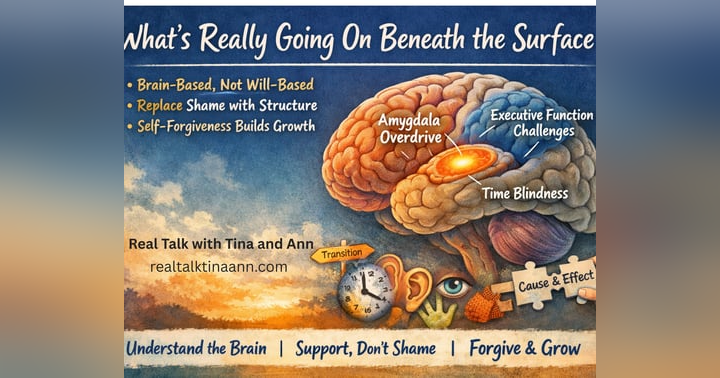
Brain Based Not Will Based