Gratitude That Tells the Truth
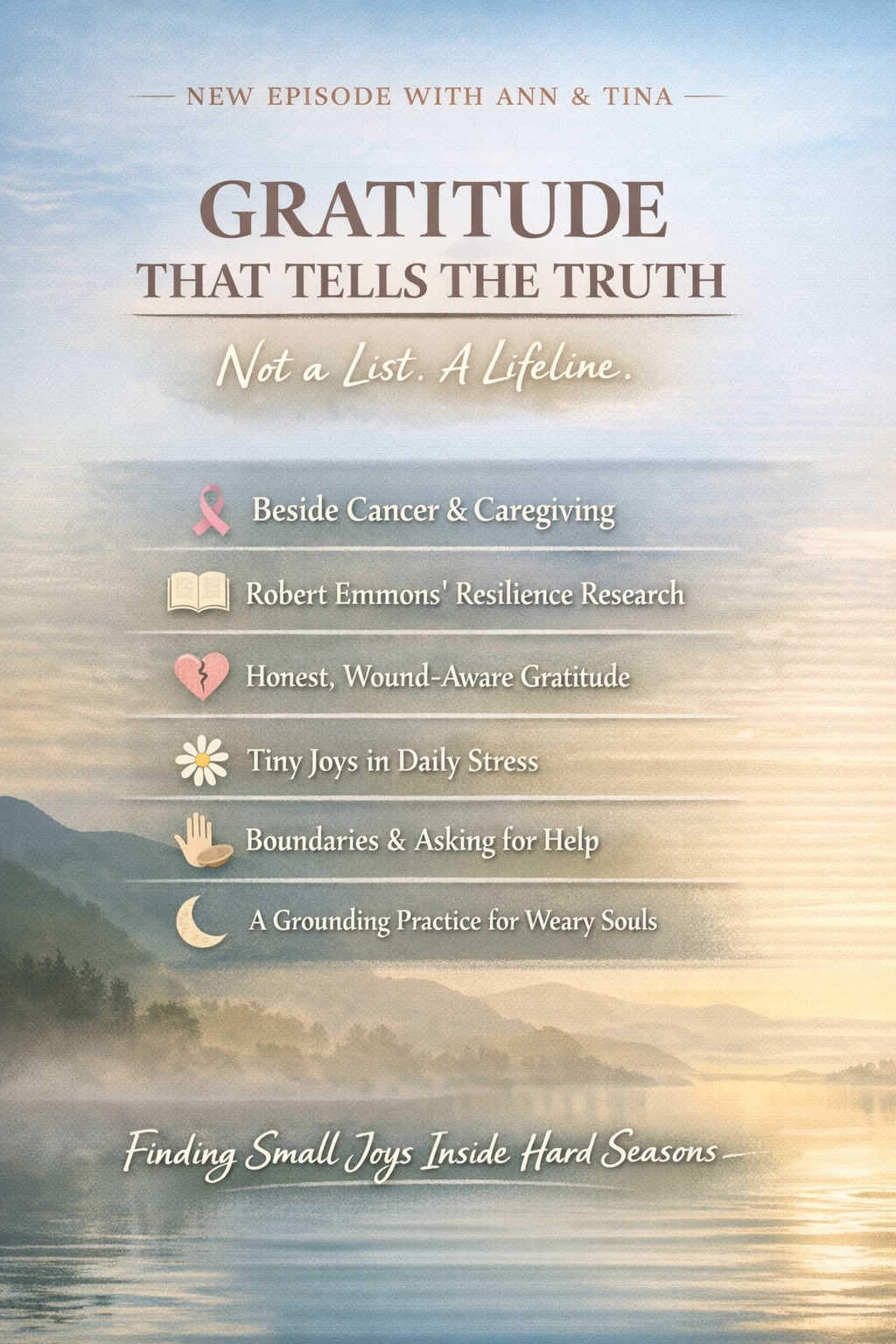
This week on the podcast, Tina and I talked about gratitude—but not the kind that gets posted in neat squares or wrapped in a bow.
We talked about the kind of gratitude you reach for when life is hard.
When cancer enters the room.
When caregiving becomes a daily reality.
When grief stretches longer than you thought it would.
Not gratitude as a list.
Gratitude as a lifeline.
I want to be clear about something up front. Gratitude is not denial. It is not pretending things are okay when they are not. It is not bypassing pain or forcing yourself to “look on the bright side.” That kind of gratitude actually does harm. It silences truth. It isolates people who are already struggling.
What we talked about instead was honest, wound-aware gratitude. Gratitude that sits beside pain instead of trying to outrun it.
Cara Lockwood’s story came up in a powerful way. Her experience with cancer—and her irreverent, deeply human wisdom—reminded us that humor and honesty are not opposites. They can exist together. Sometimes laughter doesn’t mean you’re okay. Sometimes it’s simply how you keep breathing.
Cara’s remission story isn’t about toxic positivity. It’s about agency. About choosing small moments of joy in the middle of treatment. About finding a way to stay present in a body that has betrayed you, without pretending it hasn’t.
That’s where gratitude becomes practical.
We also talked about research from Robert Emmons, whose work shows that gratitude doesn’t erase suffering—but it does build resilience. It strengthens what he calls a psychological immune system. Not in a way that makes life painless, but in a way that helps us keep showing up.
That matters.
Because when you’re caregiving, or navigating illness, or living with long grief, showing up is the work. Not thriving. Not performing “okay.” Just being here.
One of the biggest distinctions we made in this episode was between fake gratitude and honest gratitude.
Fake gratitude sounds like:
“I should be thankful.”
“At least it’s not worse.”
“Other people have it harder.”
Honest gratitude sounds like:
“This is awful—and I’m grateful for one thing that made today bearable.”
“I’m exhausted—and the sunlight through the window helped.”
“I’m grieving—and this cup of coffee grounded me.”
Tiny joys matter. Especially during treatment. Especially during caregiving. Especially on days when everything feels heavy. These moments don’t minimize the pain. They help you survive it.
We also talked about how holidays and nostalgia complicate gratitude. Traditions shift after loss. What used to feel comforting can now ache. Gratitude during these seasons isn’t about recreating the past. It’s about allowing the present to look different—and still letting something meaningful exist inside it.
Sometimes gratitude looks like letting go.
That’s where boundaries came into the conversation. Because gratitude doesn’t mean tolerating toxicity. It doesn’t mean staying connected to people who drain you or harm you. Sometimes the most honest form of gratitude is stepping away and protecting your energy. Clarity is not cruelty. Distance can be healing.
We shared a few practical tools—nothing overwhelming. Just small, doable practices that build resilience over time:
A one-line journal. Not pages. One sentence. One truth.
Gratitude texts. Sending a short message when someone helped you feel less alone.
Asking for help, without over-explaining or apologizing.
Naming one thing at the end of the day that helped you stay.
These aren’t performance metrics. They’re anchors.
What kept coming back for me was this idea of agency. When life takes so much from you, gratitude can be a way of taking something back. Not control—but ownership. Ownership of how you show up. Ownership of what you allow to matter.
At the end of the episode, we offered a grounding moment. Not to fix anything. Just to breathe. To acknowledge how tired so many people are. To remind listeners that gratitude doesn’t require strength—it requires honesty.
If you’re listening to this episode or reading this now and you feel worn down, I want you to hear this:
You don’t have to be grateful for the pain.
You don’t have to rush healing.
You don’t have to perform hope.
You can tell the truth and still find something that helps you stay.
That kind of gratitude doesn’t erase the crisis.
It walks with you through it.
And sometimes, that’s enough for today.
— Ann

Writer/Podcaster
What do I say about myself? I love telling other people's stories, but hmmmm...Let me think.
When I think about my life, I have so many chapters. I am a very compartmentalized person.
I am first of all a mom of 5 kids. Yep...5!
I am a grandma to 5 beautiful children! All gingers lol.
I am a writer, author, podcaster, oh my gosh...I've been a journalist, columnist, hard news writer for print. I have actually won quite a few awards for my writing.
I am a photographer. I LOVE getting the money shot and capturing life! I do have a website called Spectrum Photography, but I have it offline more than on because I cannot figure out how to make the pictures work on Etsy lol. I'm not good at that kind of stuff.
I very much am an autistic individual, ADHD and dyslexic. Yep I got it all lol. I'm not that great a executive functioning, but I have many great ideas! I am trying to put things into fruition, but it just takes me longer and I probably make more mistakes, but I don' give up!!!
I have had many lives in the working world. I've worked in the jail system with helping women and talking with them, praying with them. I was the director of a battered woman's shelter/rape crisis center. I oversaw the crisis hotline at the center. I worked with abused boys. I was an Assistant Director at a school for kids with autism. I was a head swim coach for 12 years. Yep--former swimmer myself lol.
I was adopted. I've adopted 5 kids. And if you want to know the history of my crazy buffet of a family lol...I will tell you, but …Read More
Brain Based Not Will Based